We use cookies to analyze and improve the website and your user experience. By clicking "Accept," you agree to our Cookie Policy.
He is one of the most esteemed abbots of Palestine, a founder of monasticism in the Eastern Church, and a magnet for countless believers. His pious life and righteousness made him worthy of the gift of miracle-working.
Saint John Damascene lived at an exciting time. The Christian Church, severely persecuted only years before, became the official church of the state. God, faith and the trinity became some of the most popular subjects of table talk.
Princess Kira Obolenskaya was a descendant of the ancient Rurik dynasty, a graduate of the Smolny Institute for Noble Maidens, and a dedicated teacher in high-poverty schools in St. Petersburg.
He was the eighth of the twelve minor prophets who lived around 650 BC. He foretold the devastation of the Jerusalem Temple, the Babylonian captivity of the Jews and their return to their homeland. He wrote the book of Habakkuk of the Old Testament.
Commemoration of the prophet Nahum has a special meaning for Saint Elisabeth Convent. We invoke his name in our prayers for the recovery and salvation of patients with mental disorders as we pursue our ministry among them.
Saint Andrew was happy to remain backstage and let his brother be in the centre. To him, pride, honour or recognition was of no importance.
Together with 370 other Christian martyrs, he suffered for his faith during the persecution of the believers in Christ under the Roman Emperor Decius.
He was instrumental in refuting the false teachings of the heresy of iconoclasm that remained prominent in Byzantine for multiple decades.
11 December — Commemoration Day of Hieromartyr Seraphim (Chichagov). In 1886, few could have foreseen that the accomplished officer Leonid Mikhailovich Chichagov would one day become a Russian bishop and martyr.
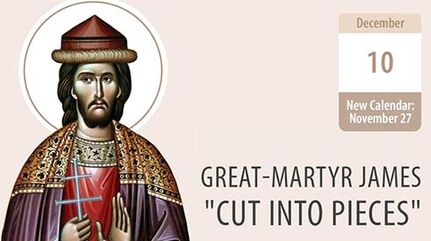
Saint John the Persian, a great martyr of the fourth century, is also called "James cut into pieces" for the terrible death he endured. His life is a story of repentance and God's ultimate mercy and forgiveness.
The Christian Church venerates saint Alypius as 'a pillar of endurance' who imitated Job in suffering and is the boast of ascetics.
Apostle Peter baptized him in Palestine. Apostle Paul referred to him as his fellow worker. Returning to Rome, he converted thousands to Christ.
Saint Catherine, a native of Alexandria, Egypt, was born in the latter part of the 3rd century. This period saw the harsh rule of the Roman emperor Maximinus, known as Maximinus Thrax, who was notably severe towards Christians.
The relics of Saint Mercurius acquired miracle-working powers, and even after his death, he continued to serve the other Christians as a soldier.
A friend of Saint Basil the Great, he was a steadfast opponent of the heresies of Arius and Macedonius, and a beloved shepherd of his flock.
The basis of his brilliant statesmanship was the great Christian virtues, and their exercise made his whole life a Christian exploit
Their lives represent the diversity of the paths to finding God and of ways of serving Him.
He spent his life as an ascetic, traveller, preacher and defender of the true faith. His righteousness and piety earned him miracle-working powers that continued long after his death.
February 7 is the birthday of the Venerable Porphyrios Kavsokalivite, one of the most famous Athonite elders of the twentieth century. He reposed in the Lord on December 2, 1991, and was canonised on December 1, 2013.
He sought to reach every heart and mind with the word of God. A paradoxical situation existed in the Russian society of the time.