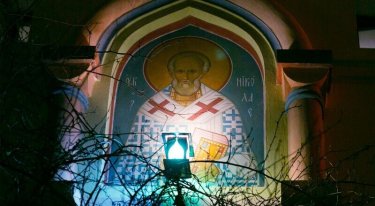
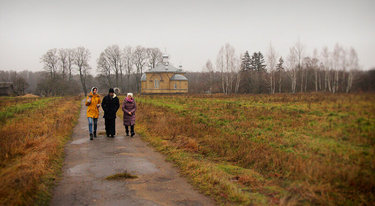
13 January — Commemoration Day of Elder Paisios of Mount Athos
Receiving the fire of divine love, you gave yourself completely to God through outstanding ascetic struggle. You became a comforter to many people, teaching them with divine words and performing miracles through your prayers. Now you pray without ceasing for all the world, Paisios God-bearer.
Troparion, Tone 5
One could speak for hours, even days, about this man of God — a soul who listened to the pain of the modern world and, throughout his life, prayed for it unceasingly.
In our time, one would be hard-pressed to find another holy man whose feast day brings 300,000 people to the place where he was laid to rest. Even among saints, Elder Paisios of Mount Athos stands apart. During his lifetime, he received a countless stream of troubled souls, drawing crowds with an almost magnetic pull. It was said that if a hundred pilgrims made their way to Athos, ninety of them were coming to see him.
The elder's compassion touched Bedouins who spoke no Greek. Even wild animals sensed it in their own way. That same love speaks directly to weary young people now, worn down by modern life. In him, they discover a gentle father figure, finding the deep care they missed. Many never met him, of course. Yet they come to his grave even now and weep, feeling his embrace from where he now dwells.
This truly universal saint feels near to Greeks and Russians alike. Perhaps this closeness comes from his spiritual bond with the Russian elder, Hieroschemamonk Tikhon (Golenkov), who guided him on Athos between 1964 and 1968. Or perhaps it is because in the 1980s, at the request of the abbot of the Russian Panteleimon Monastery, Elder Paisios welcomed brethren from that monastery as it began to revive, offering them guidance and spiritual counsel.
Elder Paisios left behind a rich spiritual inheritance. His six-volume collection of teachings, “Words”, translated into Russian and covering topics from love and prayer to family life, sits close at hand for both those taking their first steps towards God and long-standing believers. All who knew him say that meeting him was always a genuine encounter. "You opened your heart to him," they say, "and he opened your mind."

From 1978 until 1993, Elder Paisios lived and worked in his Athonite cell at Panagouda. Thousands gathered there under the open sky, in the simple outdoor reception area known as his "archondaric"*.
So how did this man — from a family of refugees, a former soldier with only basic education — become a saint who could heal thousands? How did he inspire others to follow the path of the spirit, and even foretell the upheavals of the twenty-first century?
To get to the heart of who Elder Paisios was, we must look closely at the first ten years of his life. Born on 7 August 1924 in Farasa village, Cappadocia (Asia Minor), he grew up among people steeped in the tradition of the great Cappadocian Fathers. These villagers loved their Church deeply, carefully preserved their reverence for holy things, and lived with an ascetic spirit. Throughout the year, on days of fasting, most Farasians ate food and drank water only once daily — around three hours after midday. The elder's father, Prodromos Theodosiou, came from a respected family that had governed Farasa for generations.
Amidst Turkish persecution, he had to change his surname to Enzepidis, meaning 'foreigner'. His mother, Eulogia, came from the Frangopoulos family and was related to Saint Arsenios of Cappadocia.

Prodromos and Eulogia Enzepidis, parents of Venerable Paisios of Mount Athos
A pivotal figure in young Paisios’ life was Saint Arsenios of Cappadocia, who shepherded the Greek flock in Farasa for fifty-five years. Farasa stood isolated in the heartland of Asia Minor, a small island of Orthodox faith. Father Arsenios was a man of remarkable spiritual insight and powerful faith. The Lord granted him gifts of clear sight and healing, along with a powerful prayer which, according to those who knew him, could split rock. At the age of eighty-four he baptised the future Elder Paisios, giving the child his own name. Relatives were upset — after all, the priest had asked no one's opinion, baptising the infant as he saw fit. But the saint calmly replied that this was God's will; he needed to leave behind a monk who would carry on his work. Thus, the future saint received the name Arsenios at baptism.
That same year, young Arsenios faced his first harsh trial — a difficult journey as his family fled Cappadocia for Greece**. During the sea crossing, he turned forty days old. Like the infant Christ, he fled his birthplace to escape Ataturk's harsh rule.
First, the family landed on Corfu, and later settled in Konitsa, where the saint-to-be would spend his childhood. He did well at school. Even as a boy, friends and family recalled his self-discipline and simple way of living, matched always by a deep kindness and quickness to feel the pain of others.

The house in Konitsa where Elder Paisios grew up — now a museum dedicated to the saint
In 1945 Arsenios was drafted into the army. Many times he willingly stepped into danger on the front for his fellow soldiers with families, telling them simply: "You have wives and children waiting at home — I am free." He spent most of his army service as a radio operator and was honourably discharged in 1949. After returning from war, he again answered his father's plea for support; his elder brother had married and their father struggled with life's burdens.
On 27 March 1954, after the usual trial period, the novice Arsenios became a monk at Esphigmenou Monastery on Mount Athos. He received the rassophore with the name Averky. Two years later, now at Philotheou Monastery, he was tonsured into the mantle, taking the name Paisios — in honour of Metropolitan Paisios II of Caesarea, a devoted bishop who also came from Farasa.

Arsenios Enzepidis during his military service
Father Paisios felt deeply drawn to solitude, even planning to withdraw completely to a deserted island. But God had other designs — the people needed Paisios among them.
After a time, he left the quiet of the Holy Mountain far behind. He felt called to restore the crumbling Monastery of the Nativity of the Most Holy Theotokos in Stomio. There, Father Paisios not only rebuilt and restored the monastery, he also carried out tremendous spiritual work. Many families who had drifted towards Protestantism came back to Orthodoxy through his efforts. His wisdom, compassion and humble manner quickly gained him widespread respect and affection from all who knew him. Those in need found a ready helper — he gave freely, without a second thought. He lifted up those lost in despair. Grace entered their hearts through the faith he inspired.
In 1962, his spiritual journey took him to Sinai. He settled in the desert, taking a cell named for Saints Galaktion and Episteme. There, he prayed with all his might, kept a strict fast, and worked with his hands — carving wooden crosses. The money he earned went to feed the Bedouins, who grew very fond of him.

Monk Paisios
In 1964, Paisios returned to Athos and joined the Iveron Skete. Two years later, he fell seriously ill and lost most of one lung to surgery. From May 1978, he lived in the Panagouda cell, part of the Kutlumush Monastery. For fifteen years, this was his place of quiet discipline. Illness compelled him to move, in 1993, to the women’s Monastery of the Apostle John the Theologian in Souroti — which he had founded. He fell asleep in the Lord there on 12 July 1994.
Saint Paisios possessed extraordinary spiritual gifts. His rich inner path demanded self-sacrifice, and he gave his life entirely to God, to prayer, and to serving others. He sought Christ with all his being, which is why he would say: "Even if our heart were as big as the sun, it would still be wrong to divide it into parts. So what can we possibly leave for Christ if we divide it now, when it’s only the size of a fist?” In a letter from 6 April 1969, the elder wrote: "When someone manages to free themselves from everyone and everything, only then can they truly feel God’s immense love which takes hold and makes them His servant."

Venerable Paisios with pilgrims, Panagouda, Holy Mountain Athos
One striking trait that set this holy man apart was his understanding. He had a rare ability to meet people exactly where they were. With a bishop he spoke as a bishop; with a patriarch — as a patriarch; with monks — as a monk; and with married people — as an ideal husband or wife might speak. In short, he became all things to all.
As a monk, he followed the daily cycle of worship closely: vespers, compline, the midnight office, matins, the hours. In later years, he replaced most of these services with prayers on his prayer rope. Every night he kept vigil, resting briefly just after sunset and again before dawn.
Metropolitan Athanasios (Nicolaou) of Limassol recalls visiting Father Paisios during the Feast of the Honourable Cross in 1977. “The elder suggested they hold an all-night vigil, adding that a priest would arrive at dawn to celebrate the Divine Liturgy. Around half past one in the night, the elder invited his guest to read the Order for Holy Communion. As the reading began, the elder chanted each refrain: "Glory to You, our God, glory to You," followed by the troparia dedicated to the Mother of God — "Most Holy Theotokos, save us." Each time he spoke these words, he bowed deeply in prostration. Standing near a candle, the guest read the troparion. Later he remembered: "When we reached the troparion that says 'Mary, Mother of God, the precious fragrant dwelling,' the elder’s voice caught with a deep, aching sincerity as he uttered, “Most Holy Theotokos, save us.” I was just about to continue with 'Mary, Mother of God.'

The elder's prayer
But then, everything turned around; even now I cannot explain clearly what took place. Light flooded the cell; a soft breeze seemed to sweep through the chapel, and the lamp before the icon of the Mother of God began to swing by itself. Five lampadas hung before the iconostasis, yet only this one moved steadily back and forth. I turned to the elder; he caught my eye and gestured: stay quiet. Down he bent and remained so, whilst I stood clutching the candle, though it served no purpose now — everything glowed. The light was so bright, so complete, it felt as though midday had come early.
I waited for what felt like an age. The lamp swung. The light held. The elder remained silent and bowed low. After perhaps half an hour, I started to read again by myself. I carried on through the prayers until reaching Saint Simeon's seventh prayer. And only then did the lamp finally stop its dance. The strange light vanished, and once more I needed my candle to see the words on the page.
When we had completed the Order for Holy Communion, I asked him: "Elder, what was all that about?"—"What exactly do you mean?"—"What happened in the chapel just now? I saw how brightly everything shone and how the lampada swung before the icon of Our Lady."— “You didn't see anything else?” he asked. I told him I’d seen nothing more. At that moment my mind had stopped working entirely; I was not thinking, was not trying to make sense of it. I was just… watching. The elder smiled gently. “Oh, my child, what a thing that was! Don’t you know? Here on the Holy Mountain, the Mother of God herself goes round all the monasteries and all the cells to see how we monks live and pray. She came here tonight too, saw two fools praying together and swung her lampada as a sign that she had visited." And his smile broadened.”

Appearance of Saint Euphemia to Venerable Paisios of Mount Athos (fresco)
The Mother of God was not the only heavenly visitor to appear to Elder Paisios. Other saints and angels came to see him, too. The vision of Saint Euphemia is well known. One early morning during prayer in the elder's cell there came a knock, and the elder heard a woman’s voice — on Mount Athos! "I am Euphemia," she said softly. — "Who?" he asked. — "Euphemia," she repeated and she entered, passing straight through the closed door.
She stood before him, dressed in the robes of a nun. "Which Euphemia are you?" asked the elder. "I am Euphemia the martyr, Father Paisios," replied the saint. "If you truly are Euphemia," he said, "go into my little chapel, bow three times, cross yourself three times, then sit down and we will talk." The elder worried that perhaps the evil one was playing tricks on him. She went into the chapel, bowed three times, and crossed herself. Then the elder began, "In the name of the Father..." Softly, she repeated after him, "In the name of the Father..." "Speak louder! I cannot hear you," he insisted. And as he watched her hand move to make the holy sign, he knew. He fell to his knees. "Forgive me," he said, "but sometimes the tempter plays these games." The Elder never went looking for miracles. And when a miracle walked into his life, he put it to the test.
Elder Paisios used to say that we Orthodox Christians ought to have a good, wholesome concern for our families, our Orthodox faith and our homeland — about those who believe and those who do not. Although an ascetic, he understood the times well because of this care. He did not ignore politics; he knew who the minister was and could predict events ten years ahead. Some bishops found themselves unable to explain this. What they struggled with was, in fact, his prophetic gift. For Elder Paisios the future was as clear as the present. He was a man who saw history, including that history which has not yet come to pass for us. Though thirty years have passed since he departed this life, he saw and understood the outcome of events happening in the moment; his wisdom speaks more urgently today than ever.
He pushed back against the spirit of the modern world, and it troubled him to see its influence seep even into the monasteries. Passionately, he urged modern monasticism to return to its true calling, always reminding his brothers and sisters of their path: to serve the world while working on their own spiritual growth. This same spirit shines through in a prayer from one of his finest disciples, an abbess deeply moved by his example: "My Lord, You see and know me completely. If I am mistaken, set me right again. Grant me a garment, my Bridegroom, that no one else can see. Guide me to a monastery hidden from all eyes. Grant me pure prayer without my knowing it. Help me fulfil Your will and accept my death as a penance for my many sins and as a humble sign of my love. Through the prayers of the Mother of God and my elder, amen."
Being attached to worldly things, depending on them, is to give in to the spirit of this age. Its opposite is eternity.

Grave of Elder Paisios, Souroti Monastery
The elder also cared about creating and preserving spiritual traditions in the family.
He put his finger on one of the great troubles of our age: we enjoy hearing stories and reading books, yet we are not prepared to do the work that goes with it. Few of us will bow in prayer for a neighbour, offer a short prayer for one who gossips about us, say “Lord, have mercy” for someone who treats us unfairly, or remember the departed. "Sadly, nowadays," the elder remarked with sorrow, "we have plenty of words and endless books, but hardly any practical action. People have given in to a worldly spirit that shuns hardship and avoids real effort. Most stop at reading. They do precious little beyond that. We might walk in a procession with the relics of our Church’s saints but miss the struggles they endured. Because we ourselves have not struggled, nor shared in their efforts, nor sincerely loved them enough to grow like them. Yet a Christian finds salvation by living out God's commandments, not by clever theories about the Divine. Action is what matters."
On 13 January 2015, the Ecumenical Patriarchate of Constantinople glorified the elder. Later that same year, on 5 May, the Holy Synod of the Russian Orthodox Church added Venerable Paisios of Mount Athos to their calendar, setting his commemoration for 12 July — the day he departed in 1994.
Prayer
O venerable and God-bearing Father Paisios, wise teacher who climbed the ladder of virtues from earth up to the Heavenly Kingdom and received grace to intercede for us before the Throne of our All-Merciful God, please, hear us. You patiently bore serious illness during your earthly life and offered grateful praise to God in all circumstances; thus, you were granted grace from Him to heal bodily sicknesses and restore souls darkened by sin. Standing now before the Almighty's throne, draw down His mercy towards us through your prayers. Ask the Lord to grant us strength in times of temptation, courage in our struggle against evil spirits beneath heaven, and forgiveness for all our sins — from our youth until this very day — committed in word, thought, or deed. Teach us to do good, lead lives pleasing to God, and serve those around us with love and humility. Yes, holy Father, we ask you again: help us turn away from sinful paths and produce fruits worthy of repentance and renewal in Christ our Lord. Freed from a life of sin, may we ascend with you into the Heavenly courts where together we shall glorify God — Father, Son and Holy Spirit — for ever and ever. Amen.
Prepared by the team of obitel-minsk.ru
Photographs from the internet
Sources:
1. Universities of the Holy Elder Paisios | Orthodox Portal Pokrov
2. Venerable Paisios of Mount Athos (Enzepidis) | Ortox.ru
3. Museum and Exhibition of Venerable Paisios of Mount Athos | Paisij.ru
4. Heritage of Venerable Paisios of Mount Athos | Orthodox Portal Pokrov
5. The town of Konitsa, Greece – the wild beauty of Epirus | Portal "My Greece"
6. Saint Paisios of Athos – Speech by Metropolitan Neophytos of Morphou – available online via Yandex Video search
7. Russian spiritual father of Elder Paisios
*Archondarik – in Greek or Egyptian monasteries, a special room or guesthouse used to welcome pilgrims and monastery visitors. Spiritual conversations often take place in these rooms.
**In 1924, a population exchange took place between Turkey and Greece: Greeks from Farasa in Cappadocia moved to Greece, while Turks living in Greece relocated to Asia Minor.