Hieromartyr Nicholas was born on 6 December 1875 in Arensburg, within the Estonian Governorate, blessed to grow up in the faithful home of a priest, Father Adam Simo. In 1888, his father was called to shepherd the newly gathered Estonian parish at St Andrew’s Cathedral in Kronstadt.
In 1887, young Nicholas entered the Riga Ecclesiastical School. He finished his studies there in 1891, earning first-class honours, and then went on to learn at the Riga Theological Seminary. Just three years later, in 1894, his father sent him to the theological school in St Petersburg. Upon completing his course in 1897, Nicholas married a young woman named Lydia, daughter of the Priest Pavel Panov. Soon after, on 23 November 1897, he was ordained to the priesthood for St Andrew’s Cathedral in Kronstadt. There, he took up the post that his father once held, as the older priest had moved on to serve the Estonian flock at St Paul’s Cathedral in Gatchina.

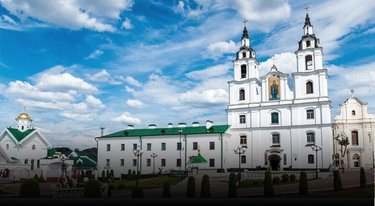
St Andrew’s Cathedral in Kronstadt
At first, the young priest could only hold services once a week, fitting them in between the early and late Sunday Liturgies. Such heavy limits, together with the needs of his Estonian flock, led him to think that a separate church was needed for the Orthodox Estonians in Kronstadt - about eight hundred people at that time.
Then, in 1902, a wonderful chance arose. The owners of a former Anglican church decided to sell the building together with its garden and house. They set the condition that it must continue to be used as a place of worship and even offered a lower price to any buyer who would honour this requirement. The merchant and philanthropist Nikolai Andreyevich Turkin offered to buy it for the Estonian Orthodox parish. The clergy of St Andrew’s Cathedral fought strongly against this plan, making it clear they did not want another church so close to their own. They went to Father John of Kronstadt to complain. Yet he did not side with their self-serving concerns. On 4 July 1902, the building was sold to Nikolai Turkin, and on 7 July he handed it over to the Estonian parish.

Archpriest John of Kronstadt and Priest Nicholas Simo
Father John of Kronstadt consecrated the building on 1 December 1902 as an Orthodox church in honour of the Exaltation of the Cross of the Lord. After the consecration, he served the Divine Liturgy together with nine priests and five deacons. The beautiful service was conducted in both Russian and Estonian.
At a celebratory meal hosted by the generous merchant philanthropist, the dean of the Estonian parishes of the St Petersburg Diocese, Priest Pavel Kulbush, spoke from the heart. He said: "Today we celebrate the triumph of a good Russian heart, thanks to which the Estonian parish of Kronstadt now has its own church and will go forward firmly on the path of inner growth... Praise and thanks to those who carried out this good work... I truly hope that every Estonian may sincerely take to heart what every Russian lives by."
Now leading the Church of the Elevation of the Cross, Father Nicholas gave his whole life to his flock. Following the example of Father John of Kronstadt, he began to celebrate the services every day. This displeased the clergy of St Andrew’s Cathedral, who complained about him to Father John. Father John once asked Father Nicholas whether it was true that he served every day. When he heard it was so, he encouraged the priest to keep up his great devotion in the service of God.
Alongside his liturgical work, Father Nicholas taught the Law of God at the Kronstadt customs school and at the Estonian parish school, which he also headed. He led the Kronstadt branch of the Alexander Nevsky Society of Sobriety and served on the committee of the Kronstadt Guardianship for People’s Sobriety.
In 1910, his wife died, leaving him with three young children, aged from three to seven.
Father Nicholas walked the path of a brave defender of Orthodoxy, and over time his ministry won ever greater respect among the faithful of Kronstadt - not only Estonians but Russians as well.

Hieromartyr Nicholas Simo
In 1917, one of the priests of St Andrew’s Cathedral died, and the vacant post needed to be filled. By then, the church had brought back an old custom: the flock would vote for their new priest, and the bishop would then approve their choice. Three candidates were proposed. Of the 385 parishioners who voted, 317 chose Father Nicholas.
"Priest Nicholas Simo is known in Kronstadt as a kind and modest shepherd, and the vote shows that the sympathies of the parishioners of St Andrew’s Cathedral are on his side," wrote the dean, Archpriest Grigory Pospelov.
On 13 December 1917, Metropolitan Veniamin (Kazansky) of Petrograd appointed Father Nicholas as a priest of St Andrew’s Cathedral. In 1919 he was elevated to the rank of archpriest, and in 1923, after the death of the rector, he was appointed as the new rector of the cathedral.
The authorities first arrested Father Nicholas in March 1921, suspecting him of taking part in the Kronstadt uprising. They released him after two weeks, however, as they could find no evidence of any wrongdoing on his part.
When the Renovationists tried to seize control of the Church, Archpriest Nicholas openly opposed them. Around that time, a meeting was held for twenty supporters of the Renovationist cause at St Andrew’s Cathedral. Speaking before them, Father Nicholas clearly stated that both the Renovationists and the Living Church were heresies. He pointed to their new rules - rules that broke the canons of the Church, like letting clergy marry for a second time. Later, a man from Petrograd came with a plan to organise a grand meeting of the twenty members and the clergy from every Kronstadt parish. Archpriest Nicholas and the clergy of St Andrew’s declared they would not go to any gathering run by a Renovationist priest. When asked how to respond to the invitation, Father Nicholas replied that his men would never follow the Renovationists. He was warned that this might lead to arrest by the civil authorities. "Let them arrest me - my bag is already packed," Father Nicholas replied.

Fresco image of St Nicholas Simo in the church in Saint-Petersburg
Archpriest Nicholas was arrested on 13 October 1930. The authorities swept up sixty-four people into the case, all of them followers of Father John of Kronstadt and defenders of the monarchy. St Andrew’s Cathedral, in the eyes of the officials, had become a hotbed of counter-revolutionary activity among the clergy. Archpriest Nicholas gave the secret police (OGPU) nothing they were after. Yet, the investigators kept pushing, until at last Father Nicholas declared, "I refuse to make any further statements..."
While he was under investigation, the OGPU began arresting those who disagreed with Metropolitan Sergius (Stragorodsky)’s declaration. For convenience, the investigation grouped them into an "all-Union counter-revolutionary organisation of "True Orthodox."" One such case was opened in Leningrad. On 14 February 1931, the cases of Archpriest Nicholas Simo and other clergy and laity of Kronstadt were added to it. Through all this, Archpriest Nicholas held firm. He remained silent and did not respond to the OGPU’s questions.

In their final charges, the state officials wrote: "The leaders... of the centre were extremely monarchist elements, formerly the closest associates of John of Kronstadt himself, men who, by means of open propaganda, carried out angry anti-Soviet agitation with the aim of undermining and overthrowing Soviet power... At the head of this organisation was the priest of St Andrew’s Cathedral, Nicholas Simo, who, during the lifetime of John of Kronstadt, carried on monarchist pogrom work".
On 13 April 1931, the OGPU Collegium sentenced Father Nicholas to death by shooting. Archpriest Nicholas Simo was executed on 18 April 1931 and buried in an unmarked grave.
Source: Hegumen Damascene (Orlovsky) "Lives of the New Martyrs and Confessors of Russia, 20th century. April." Tver, 2006, pp. 41 - 46