For Orthodox Christians, obedience means entrusting one’s life to God with a clear mind and a willing heart. It is the opposite of passivity: it is attentive listening that turns daily labour into a living prayer.
At St Elisabeth Convent, this spirit animates our workshops. Whether preparing meals or laying gold ground, we learn to let God set each piece in order. In today’s interview, a veteran mosaicist shares how this simple, steady obedience gathered a scattered life and taught him that nothing is “extra” — not a stone, not a soul.
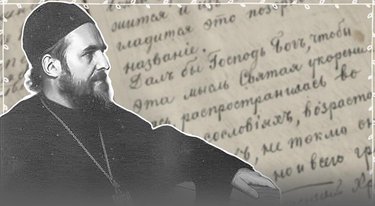
“I usually introduce myself simply: I’m Uncle Vanya,” he smiles. “My name is Zufar, but at Baptism I received the name Ivan — Vanya — so the nickname stuck; and with the grey in my beard and a few more years than the other artists in the shop, the ‘uncle’ came naturally.”
Ivan didn’t only change his name. His road ran from a restless youth and far-flung spiritual searches to Baptism and a workbench in a monastery workshop. For nearly fifteen years he has been laying tesserae — and he is convinced that in a true mosaic every stone finds its place, just as every person does, by learning to hear God.
“I was born in Kazan, on the Volga, in a Tatar family. By the time I finished school I was a free, searching young man. I wanted to see the world, to know everything. Looking at the greyness around me, I wanted to run into the street and shout, ‘Hey — stop!’ Life is beautiful; it’s not only school–army–institute–work. My soul was asking for more — for a song.” In those officially godless years his spiritual search began: philosophy, Buddhism, Krishna-consciousness — exotic religions that seemed beautiful and mysterious at first glance.
It was not a comfortable life: sometimes you skipped meals, caught a ride in a freight car or on the top bunk of a train, walked in worn-through sneakers, slept on a blanket in a stairwell. But the chance to see the world felt worth it. On 1 June — Children’s Day — they would always gather: “We were the Flower Children (the Soviet hippie movement), and we loved children; in a way, childlikeness was our ‘ideology’.” The Gospel itself points the way: “Unless you turn and become as little children, you will not enter the Kingdom of Heaven” (Mt 18:3).
That childlike way of seeing — wonder, joy, the ability to be moved by nature, by sunrise, by the northern lights — he now recognises as a real help on the road to God’s Kingdom. Perhaps that is why many from that circle eventually came to Christ — some even becoming priests and monastics.
“I once stopped in Moscow for the night and found a few respected, older hippies talking quietly in the corner — men who had recently been baptised. It was a fasting day. They poured boiling water into a packet of instant mashed potatoes, and that was supper. One of them kept urging me to be baptised. His words about Christ stayed with me, and I left with a firm resolve.” He smiles: “I’m not a very driven person — usually I just drift. But this time it hit me. Back in Kazan I simply stood up and went — didn’t even know where exactly. I walked into a little church and asked to be baptised. And so, in 1986, during the week of St Mary of Egypt in Great Lent, I became a Christian.” “Only later did it dawn on me that God had simply taken me by the scruff of the neck and led me to Himself. That was a very concrete act of God. We think ‘grace’ and ‘the Holy Spirit’ are big words — but without them nothing truly happens in our lives. We just don’t always realise it.”
“Right after Baptism, though, I didn’t yet settle into church life — I set off travelling through Central Asia: Bukhara, Samarkand… They had given me prosphora at Baptism, and I took it with me. Each morning I slipped away to eat a small piece. The blessed bread from the Liturgy, although not Holy Communion itself, felt like a fragment of another world, and I wanted to keep that world hidden from curious eyes.

We reached Lake Issyk-Kul in Kyrgyzstan. Along one flat shore the sea-buckthorn grows thick; at dawn pheasants rise from the bushes, and across the water the mountains stand with snow on their peaks. You look — and you understand that God is in this.”
“There was a season when my life no longer lined up with Christianity. I took off my cross and laid it carefully in a box.” A friend then invited him to visit Fr. Nikolai Guryanov on Zalit Island. “I decided I wouldn’t go up to the elder — after all, I was without a cross — so while my friend went in, I wandered off toward the water. But he called me back. Father Nikolay anointed me with oil twice and said simply, ‘Go.’”

Back in St Petersburg during the Nativity Fast, he began reading spiritual books. “At some point it just broke through: I saw myself. I don’t know if you’d call it repentance, but it hurt — I wept. I realised I was walking the wrong road.” He opened the little box, took out his baptismal cross, put it on, and said, “Hello — I’m back.”
He returned to Kazan, where an old friend, Maxim, was training in iconography and later became a well-known icon painter. At the Raifa Mother of God Monastery he helped gesso icon boards and slipped, slowly but surely, back into church life — services morning and evening, even witnessing monastic tonsures. There followed seasons at Optina Hermitage, the Pskov-Caves Monastery, and Valaam. Later, on Sviyazhsk Island near the Bogoroditse-Uspensky Monastery, Maxim painted icons while he prepared boards.
“Living around the monasteries, I began to feel it deeply: we belong to another world.” He smiles. “Not in the sense of escaping life, but of discovering where life is truly alive. Morning and evening services, the slow warmth of Lenten meals with the brethren — nothing glamorous, but nourishing to the soul. I helped with the simple things — preparing icon boards with gesso, sweeping, running errands — whatever was needed. I stood through long services and watched the brothers at their prayer and work. Little by little, that rhythm began to remake me from within.”
He had spent years beside icon painters. “Iconography never really ‘opened’ for me; to be an icon painter you really have to be an artist, and I had neither the training nor the skill. But even standing just outside that art, I sensed it building a different country inside a person — the true homeland. I knew I wanted to serve that world somehow, even if only in small, hidden ways. And when you want that, God finds a path for you you did not expect.”

“When Maxim moved with his family to Pskov, I stayed on the island. Leafing through icon albums one day, I saw mosaics — and something clicked. Given my usual lack of decisiveness, I’m sure the Holy Spirit nudged me. I thought: laying stones might be more accessible than painting icons. I was already fifty. It was time to change my life.”
“By then my parents had reposed, and I had inherited their flat. One could have just settled down — but I didn’t. I started phoning mosaic studios in Moscow and St Petersburg. The Academy in Petersburg wasn’t admitting anyone at the time. Someone gave me the numbers of two seasoned mosaicists who ran paid courses. I went to study. In a month I grasped the process, learned what kinds of smalti there are and where to get them, and even made a small mosaic.”
“Just then a friend from Kozelsk — Katya — came to Petersburg to renovate her mother’s place. I offered to help. Her mother is Nun Pelagia. We talked; I told her about my new passion. She said, ‘There’s Dmitry Kuntsevich in Minsk — he heads a mosaic workshop. I’ll call him now.’ They spoke, and Dmitry invited me to come.”

“I arrived in Minsk for a few days and lived in a trailer. Dmitry asked me to lay a background. He noticed how I approached things and told me I had the right way of thinking suited to the work. I went home, rented out my flat, and moved to Minsk. They settled me together with the brethren — it felt like paradise. I joined the brothers’ life entirely: rule, akathists, the Psalter, services every day of the first week of Lent, simple Lenten meals in the refectory, even sisters’ meetings. I lived in the brotherhood house for a year and a half. After some time I returned to Kazan, sold my flat in a month and bought one here, though everyone said it was impossible — before I knew it, it was settled. That was the Lord’s hand.”
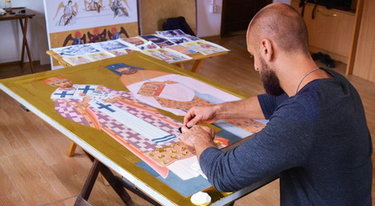
“In mosaic they teach you to imagine an invisible thread running through the middle of each row. You lay the smalti as if you were stringing beads on that thread. There has to be a hidden centre.” Then comes the lesson you only learn with time: “An artist must trust the stone — and the process.” Gold, once it’s been split into tesserae, comes in all shapes. “Ideally, when you’re laying a background, you take a handful of pieces and simply place one — then, without sorting or picking, you take the next from your palm. Backgrounds teach you to trust the work. You scoop a few tesserae into your palm and set one down. Then, without sorting or second-guessing, you take the next, and the next. No piece is ‘spare’. Where you’ve placed it, that’s where it belongs. Once it’s been cut and brought into the work, you don’t cast it off; you help it find its place.”

The metaphor widens: in God’s world, nothing genuine is pointless. “Wheat, water, grapes — each has its own purpose. And every person, too, finds a place in life. There is no ‘unnecessary’ person, even if someone seems unpleasant to us. So it is with stones: there are no ugly stones. Each has a history — sand and glass refined by fire and changed. Humanity is called by God to transfigure creation, to till the garden. Mosaic is a modest way to do the same — earth, sand, and glass transfigured into beauty.”
“The first time I stepped into the Convent’s main church, the mosaic of the Mother of God struck me — pure masterpiece. When the Six Psalms begin and the lights are dimmed, you stand there with only the candles burning, and the gold ground lives. Each tessera has facets; the light plays over them and hints at the Divine, the Uncreated Light. Everything we see is a sign of that other world.
In the workshop I mostly lay backgrounds. Many assume the figural passages — especially the facial modelling — are the ‘serious’ work, and the gold ground is mere infill. In truth, there isn’t a single ‘extra’ piece in a real mosaic — everything can speak of the other world.

There was a season when they let me lay garments, and my heart leapt — I understood at once why everyone works at it with shining eyes. Still, even the quiet labour of the background gathers the soul: row by row, the hidden centre holds, and beauty begins to breathe.
Dmitry says it often: Look to the ancient models. This isn’t our own invention; it has been given from age to age. By laying mosaic today, you enter that lineage of the Church’s art. In the work of the old masters we sense communion with those ascetics — and, since they were moved by the Holy Spirit, their art opens a living link to the spiritual world.”

In the workshop we don’t only assemble mosaics; we ourselves are being rebuilt. Each of us carries fractures; our poor soul feels bound and dimmed. Yet contact with true masterpieces gathers the soul — most of all when we ourselves help bring that harmony to light.”
Ivan’s conviction mirrors the work of his hands — no tessera is ever wasted: “I’ve been in the workshop for almost fifteen years now. Today I know I am where I’m meant to be. From my Baptism onward, God has cared for me — in little things and in great ones — and everything that has happened has been right and needful. There are no mistakes; everything is in its place.
“Life, I’ve learned, is obedience — learning to hear God. When you do, He makes a life hold together like a work of art. If the Lord prompts, move; if He redirects, follow. Take what’s set before you — don’t overthink it and don’t stash it for later. We hedge: ‘What if this isn’t for me? What if I don't like it?’ We reach for what’s prettier and easier.” He smiles at the memory of his own dithering. “These days I try to trust.”

“The Lord leads — even by the scruff of the neck sometimes — pushing you to do something against your own understanding. Believe first; later you’ll see why. The One who compels you is not a stranger — He is God. That is the best thing that can happen to you, so refusing would be foolish.”
“God calls every person. We only need ears to hear and the courage to follow. God is nearer than we think — He is close.

Any craft is the honing of a skill; so too we must train our ear for God’s will, as musicians train their musical ear. All of life should be such training. And when you have learned to obey, at the end you’ll hear the final word: ‘Come in’ — you’ve arrived where you were meant to be.”
Prepared by Olga Demidyuk