In today’s secular culture, the word obedience is often associated with blind submission, loss of freedom, or the suppression of one’s personality. In the Orthodox understanding, however, obedience means something quite different. It is a voluntary act of trust — a conscious decision to place the final word in one’s life in God’s hands. Through obedience, a person learns to listen more deeply: to God, to others, and to the inner movements of the heart. It is a path of freedom, not constraint, where work becomes prayer and daily labour becomes a means of communion.
At St Elisabeth Convent, obedience takes many forms. Some sisters serve in silence, others in constant interaction with people; some work with their hands, others with organisation, care, or words. Yet in every obedience, the same inner work is at play: learning to set aside one’s own will and allow God to act — patiently, gradually, and often in unexpected ways.
In this interview, Nun Xenia (Teymurova), head of the Convent’s Stone Inlay Workshop, reflects on a long journey toward loving her obedience. Her story is not about mastering a technique, but about being shaped by it: learning to lead without dominating, to serve without withdrawing, and to discover, through daily labour and human relationships, what it means to entrust one’s life to God.

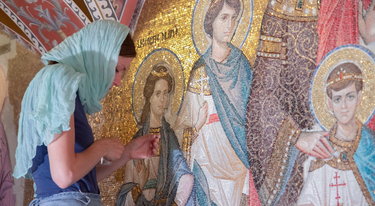
On the table in the workshop stand dozens of small bowls filled with crushed stone in every colour. The artists apply adhesive to a marble tile and, with a tiny spoon, carefully sprinkle mineral chips onto the surface. The stones catch the light and shimmer — and a quiet miracle takes place: icons and landscapes come alive.
This art form came to Belarus from the Urals, where many minerals are mined. The Stone Inlay Workshop traces its origins to a studio attached to an institute of geology, where artists created stone landscapes. Later, several of them began working with our Convent, and the workshop has now existed for more than twenty years. Here, icons, landscapes, angels — even portraits — are made from crushed stone.
“From a distance you’d think it was painted — it’s done that finely,” Mother Xenia says, looking at one of the pieces.
— Mother, what do you use to make these icons?
— In our Stone Inlay Workshop we use only natural stone. Much of it comes from geologists, and the palette is truly wide: azurite, lapis lazuli, turquoise, malachite, cinnabar, astrophyllite, and more. For garments and halos we often use coral, amber, onyx, carnelian, natural pearls, amethyst…

The technique itself is very precise. Crushed semi-precious stones are applied to adhesive on a marble tile. Fine grains are used to render faces and distant views, while larger pieces give depth and texture to garments, adornments, and whatever lies in the foreground. From afar, the image often looks painted.
Many icons are further embellished with pearls and natural stones. They are durable, but we still recommend keeping them in kiots — both to protect them from dust and to show their beauty to best effect.
— How did this workshop begin at the Convent?
— When our monastery was just beginning to take shape, Alexander Ganichev — one of the artists who worked with this technique — joined the Convent’s community. With the blessing of our spiritual father, Archpriest Andrey Lemeshonok, it was then decided to establish a Stone Inlay Workshop here at the Convent.
It was 1999, and we didn’t yet have suitable premises. The nearby hospital offered a basement space, and the first icon painters, ceramic artists, and our stoneworkers laboured there.
Later Alexander brought other artists from the Institute of Geology, and that’s how our workshop took shape. Over time the artists learned to do everything themselves — because no one teaches this technique anywhere.

At first, of course, they made icons “as they saw them”. Later they began taking their designs to an icon painter from the Convent’s icon-painting studio, and in this way they grew.
For two years, when the workshop was already working near the monastery, its artistic director was Priest Sergius Nezhbort — an accomplished icon painter and the head of our Convent’s icon-painting studio. Naturally, he set a standard for everyone. Father Sergius didn’t merely point out what to correct; he spoke about the meaning of iconography itself. He would say:
“You must put your soul into an icon. Make it so that a person cannot simply pass by — so that he stops, and looks.”
— Tell us how you came to the workshop. Do you see it as God’s providence?
— The workshop has existed for over twenty years, and I came to it eighteen years ago. My first obedience in the monastery was washing dishes. Then I was blessed to work in the gold-embroidery workshop, and I stayed there a year and a half.

It was a very grace-filled time: prayer, quiet, solitude. It seemed to me that everything was in its proper place — I serve God, I pray, I embroider. There was deep joy in the Lord, and I’m grateful to God for it. I needed that season, so that my soul could grow stronger in prayer and later endure a more active life, full of bustle, without losing the bond with God.
But that season came to an end. After a year and a half, Father Andrey transferred me to become the head of the Stone Inlay Workshop. It was hard to accept, because being the senior sister means responsibility. You have to resolve difficult questions. And you realise your whole way of life is changing.
Yet I think what is precious to God is this: when a person is willing to accept what He gives. We may prefer one thing, but our spiritual growth may require another.

I didn’t know the technique at all. I came to the workshop, sat down, and the craftsmen began teaching me how to apply the stone. When I became more confident, I started assigning tasks, ordering materials, and communicating with customers. Step by step, gently, the Lord led me into this obedience.
— After eighteen years, do you understand why the Lord placed you here?
— I’ll say honestly: only quite recently did I come to love my obedience. Before that I was here outwardly, but in my heart I was still living in other obediences. At that time I was also reading in church services, singing at molebens and memorial services, and giving tours.
Then I fell ill for a long time, and afterwards I could no longer read, sing, or lead tours. I don’t think the Lord took these things away for no reason. I was left with one obedience — the Stone Inlay Workshop. In other words, the Lord was leading me so that I would accept it not only with my hands, but with my whole heart.

And something shifted. I became genuinely interested in the work. It is creative and many-sided. It also involves constant contact with people — and in that I see service to God through service to others.
You have to stay sober-minded and watch what face you bring into the workshop. St Isaiah says that when you are alone you should keep contrition before God, but when you go out to people you should have a kind and welcoming countenance. It matters so much to say a good word, to help, to sympathise, to encourage, to listen.
And not only to the artists. I also speak with customers and suppliers. Even over the phone you can unsettle a person by your tone. So you have to forget yourself — your own interests — and think of the other person. Endure. Humble yourself. Keep silent when needed.
The Lord tells us: “Learn from Me, for I am gentle and humble in heart, and you will find rest for your souls” (Mt 11:29). My obedience teaches me exactly this.
— What does it mean, in practice, to love your obedience?
— When you accept it with your whole heart, you begin to love it — and to give thanks.
At first it wasn’t easy for the artists working with me. I can be demanding, and at times I spoke too sharply — insisting on my way. But they are creative people, each with their own vision.
When I look back and compare who I was at the start of this obedience and who I am now, I see how the Lord slowly polishes my soul and leads me towards salvation. And I thank God for it.
I won’t take kiots and icons into eternity — all of that will remain on earth. What I will carry with me is my communion with God, my faithfulness in obedience, and the way I have loved the person beside me.
The Holy Fathers say that the dearest person to you is the one who is next to you right now — because, in that moment, the Lord stands between you.
— Was it hard to be in this obedience without an artistic education?
— Nun Sophia, an icon painter, reviews each icon for faithfulness to the canon. After that the artists also show it to me, because I hand the icon over to the customer, and I understand what the person hopes to receive. The artists had to humble themselves and accept remarks from me, even though I am not an artist.

And yet, even without being an artist, I can see when, for example, an eye needs the slightest adjustment, or when something is off in the colour. At first they were surprised: “How can you see this — you’re not an artist!”
I told them: I was blessed into this obedience by the Lord, and so He gives me the ability to notice what is needed. If I’m sent to another obedience later, I won’t see these things — because I won’t need to. This is God’s action.
— Does prayer help you sense God’s action? How do you keep this bond with Him?
— In this obedience I feel my complete dependence on God especially strongly, because I ask for His help constantly — in relationships with people, and in solving difficult matters in the workshop.
You must remember God. Ask Him each minute how to act; what word to say to an artist, so as not to grieve him. Before a difficult call with a customer or supplier, I always read “O Heavenly King” or the Lord’s Prayer — and only then do I dial.
Only recently have I begun to understand that I must not worry, but place everything into God’s hands. He will help; He will arrange things in the best way for everyone.
I never saw myself as an organiser — but the Lord knows me better than I know myself. Perhaps I have no such talents; but God’s strength is made perfect in weakness. I say: “Lord, You see that I cannot do this. Help me! You know; You can; You are strong.”
— And you also have common prayer in the workshop, don’t you?
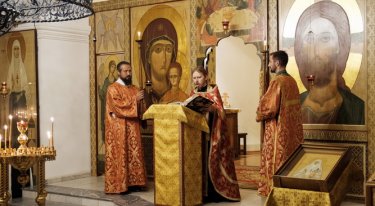
— Yes. Our day begins with prayer — the Akathist to St Nicholas the Wonderworker. Together with the workers from the icon-casing workshop we sing troparia to the saints, read a prayer for peace, and a prayer for unity.
After lunch we read the Apostle Paul’s Epistle and the Gospel of the day. Then we say ten Jesus Prayers with bows — asking the Lord to give us strength to labour and to enlighten our minds.
And the Lord does give it. By the Holy Spirit’s grace, the icons come to life.
Once a month Father Sergius Nezhbort serves the Divine Liturgy in the house chapel at the House of Diligence (Dom Trudolyubiya), our Convent’s rehabilitation and work centre. That, too, draws us together.

— How would you describe the relationships in the workshop?
— The workshop is a family. Each soul has its own relationship with God, and only God knows how another person experiences Him — but I can see the unity between us.
When the artists come in the morning, they are genuinely glad to see one another. They smile. They ask, “How are you?”
They talk through difficulties together. They find comfort and support here. And they have one very good quality: in their work they do not trust themselves.
An artist will make an icon, and then go to an experienced icon painter — for us, that is Nun Sophia — and ask, “At this stage, what should I correct?” They can also come to each other and say, “That turned out so well — it’s beautiful!” Or: “Here, it seems to me the ornament needs a different stone.” And they begin choosing together.

Especially when they are working on an icon with many adornments — then, of course, it turns into a whole council. Everyone wants it to be as finely adorned as possible. For God, we do our very best.
We don’t have a high turnover. The workshop still has artists who were there from the very beginning, and later a few more joined. Now there are seven of us.
By nature I’m a rather closed person, and it wasn’t easy for me to take so many people into my heart at once. But the Lord gradually widens the heart. Elder Sophrony (Sakharov) said that if we can take even twenty people into our heart, we will be able to take in the whole world and pray for the world.
But to “take in” means truly to accept — with weaknesses and shortcomings. It is hard labour.
Now it is a consolation to enter the workshop and see the sisters’ faces. It is also a consolation to meet and speak with others. The Lord placed me here so that I would struggle against my closedness: because when we close ourselves off from a person, we close ourselves off from God.
Little by little the Lord revealed to me that if I do not love a person, if I do not trust him, then I do not trust God.
— Which icons are ordered most often?
— It’s hard for a person to be alone. Loneliness is pain. And this is often what lies behind people’s choices. That is why, besides the usual pairs — “The Saviour” with the Kazan Icon of the Mother of God, or “The Saviour” with the Vladimir Icon of the Mother of God — one of the most sought-after icons is the Holy Right-believing Prince Peter and Princess Fevronia of Murom.
As soon as we send that image to the shop, it sells out at once. It’s bought by people who are alone and want to build a family; and by families who want to live in love and unity, as these saints did.

People buy it as a wedding gift — for a crowning, for a wedding day. In fact, many of our icons are purchased as gifts.
Orders come through the online shop from many countries — from America, France, Russia, even Australia. And people write to thank us: “This icon is of astonishing beauty,” “It’s a blessing for our family.” Glory to God! So the labour is not in vain.
— Is the gratitude of customers the happiest moment of your obedience?
— One of the happiest moments is when an artist sees the finished icon and understands that people will pray before it. There is such fullness in that feeling: the Lord has created such beauty!
And when gratitude comes from a customer, of course that is also a joy.
— Do people order these icons for their homes, for private collections, or for churches?
— The maximum size of our marble tile is 30 by 40 centimetres, plus the kiot. For churches, larger icons are usually needed.
Still, it has happened. A parishioner from the Church of St Alexander Nevsky ordered, as a gift to the cathedral, an icon of Blessed Matrona of Moscow and Blessed Xenia of St Petersburg.
Churches and monasteries also purchase our icons for their candle shops. So our icons and landscapes end up in many different places.
— What, for you, is the difference between a painted icon and an icon made in your workshop?
— I love painted icons too. When we bless icons in our workshop, we invite a priest. During the blessing, painted icons and stone icons lie together, and I admire both.
In the stone icon, perhaps the most striking thing is the “living stone” itself. We always make opening kiots for our icons, so that you can open them, look at the stone, even touch it. Our artists especially love working with stone — they love the material itself, and the way you engage with it.

Into the main stone we add minerals that give a shimmer to garments and background. For example, astrophyllite and pyrite give a golden glow; galena gives a metallic sheen. They sparkle. If you place a candle before the icon, or switch on electric light, the stones begin to play with every facet — and there appears a kind of royal splendour, as befits an offering to Christ our King.
— What is the monastery for you?
— The monastery is an ark of salvation. All who live and labour in the Convent are within it, and Christ is at the helm. And we sail in the right direction — following Christ.

Interview by Olga Demidyuk
Photographs by Maksim Chernogolov