12 August – Commemoration of the Holy Martyr John the Warrior
You appeared as a good servant and soldier of the all-bountiful God and King, O John, wonder-worker. Having suffered manfully for the faith and completed your course in blessedness, you now behold the Creator of all, the Lord, in the radiant glory of heaven. Receiving from Him the gift of miracles, you help those who suffer in every affliction; you strengthen soldiers in battle and deliver them from captivity, wounds, sudden death, and grievous misfortunes. Therefore pray to Christ the Master, O ever-memorable one, that in every circumstance He may show us mercy, preserve us from temptation, and save our souls, for He is the Lover of mankind.
Troparion, Tone 4
However many pages the life of a saint may occupy in the Prologue, we still know very little about his life in Christ. That life remains a mystery of the soul. Details of childhood, education, and the number of years a saint spent on this earth before ascending his Golgotha and being crucified with Christ can only tell us so much.
Yet this mystery is sometimes partly revealed when, at some narrow point in our own lives, we come into contact with the narrow path by which the saints walked to salvation. Most often this happens in trials, sorrows, and illnesses. And as a rule, the point of contact is the saint’s real and effective help in a difficult moment, given in response to prayers addressed to him. Then personal spiritual experience appears, and the saint quite clearly “enters” our everyday life.
The Holy Martyr John the Warrior is present in our lives in just this way, although seventeen centuries separate us from him. “Holy Martyr John the Warrior, help me – I’ve lost my phone!” “My colleague is making my shifts unbearable.” “I am going on a dangerous mission; protect me from the enemy.” These, and countless other requests, are heard by Saint John the Warrior, and he helps.
Judging by the number and variety of his icons, the martyr John the Warrior, or war-like, as he was also called in Rus’, is one of the most venerated saints in our land. Yet very little is known about his earthly life. In some accounts of the saints, his Slavic origin is mentioned. He was buried in the Constantinopolitan district of Pandectes, where foreigners were often laid to rest, but there is no reliable information about where he was born.
John was a Christian and served in the Roman army during the reign of Julian the Apostate (361–363). This pagan emperor, who had renounced the faith of Christ, began a new persecution of Christians. Julian sent punitive detachments of soldiers throughout the empire, ordering them to deal harshly with believers in Christ if they refused to take part in pagan sacrifices.
John was placed in command of one such detachment. Outwardly, he appeared to be a severe persecutor carrying out the emperor’s orders. In reality, he gave great help to his fellow Christians. He warned them of approaching danger; when his soldiers managed to seize believers, he would release them under various pretexts or help them escape. The saint spent his life in fasting and prayer. Moved by compassion for all in need, he gave his pay to the poor, visited the sick and oppressed, and did whatever he could to ease their suffering.

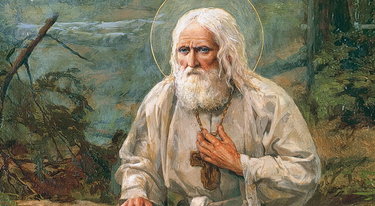
Icon of the Holy Martyr John the Warrior. Russia, 19th–early 20th century
This could not continue for long. John was denounced to the emperor. Enraged, Julian ordered the rebellious commander to be brought to Constantinople, tortured, and then executed. John was seized, taken to the capital in chains, and thrown into prison.
Knowing from experience how skilful and merciless the imperial executioners were in their dreadful trade, John began to pray to the Saviour:
“Lord, You see how weak and frail I am. Support me and strengthen me. If You do not come to my aid, I will not withstand the tortures, Lord.”
During one such prayer, he heard the grinding of a lock. The cell door opened. They had come for John.
“You are free.”

Unable to believe what was happening, John continued his prayer.
“You are fortunate, soldier. Your release has come. Julian has died in battle against the Persians, and the new emperor has issued a decree releasing all imprisoned Christians.”
Set free, Saint John devoted the rest of his life to serving his neighbours and lived in holiness and purity to a great old age. He asked to be buried in a cemetery for the poor and for strangers. When he reposed, all the poor of Constantinople accompanied him on his final journey. In time, however, his grave was lost among the other nameless graves.

Saint John the Warrior. Fragment of an icon, second quarter of the 18th century, Yaroslavl
Decades later, a poor widow living near the cemetery noticed an unearthly light shining above one of the graves. Not knowing what to think, she remained perplexed. That night, in a dream, a warrior appeared to her, told her about himself, and revealed his name. She went to the priests and showed them the place where she had seen the light. Then, with great honour, the incorrupt relics of the Holy Martyr John the Warrior were uncovered, and many miracles and healings took place through them. The shrine was placed in a reliquary in the church of the Apostle John the Theologian in Constantinople.
One day, thieves broke into the poor widow’s house. Finding no valuables, they decided to carry off whatever they could. Suddenly they saw a warrior in armour standing behind them. He commanded them to put everything back. Terrified, they dropped their plunder and fled. The mysterious protector frightened them so much that the next day they came to the widow and asked her forgiveness. There, on the wall of her house, they saw an icon and recognised Saint John the Warrior, the one who had stopped them the night before.
Since then, a tradition has arisen of praying to the Holy Martyr John the Warrior for the recovery of stolen things. And, of course, through Saint John’s prayers, consolation is given to the offended and sorrowful, and to those in prison and captivity.

Church of Saint John the Warrior on Bolshaya Yakimanka in Moscow
Saint John the Warrior was especially venerated in Rus’ during the reign of Ivan the Terrible, when the streltsy chose him as their patron. In Moscow, near the Kaluga Gates, a church was built in his honour by order of the Tsar. Later, with the support of Peter I, it was moved from the lower reaches of the Moskva River to Yakimanka Street.
Services were always held there, except for a short period during the French invasion. The church doors remained open even after the October Revolution and throughout the Soviet period. The Church of the Holy Passion-Bearer John the Warrior still stands today.
In the Russian Church, Saint John the Warrior is revered as a great helper in sorrows and in many earthly circumstances.
Our convent, too, has come to know this help in a way that touched the very course of its life. At the beginning of the monastery, our community stood before a fundamental choice: whether to become, like the majority of monasteries, a closed community of prayer and contemplation alone, or a community dedicated to service and open to the world. The choice was far from simple, for each path carried its own dangers. And so the sisters laid this question, so decisive for our future, before the Holy Martyr John the Warrior, asking his help. The answer came. More and more sisters found their hearts inclining toward a community of service, and they were confirmed in this by the blessing of Metropolitan Philaret, then Primate of the Belarusian Orthodox Church.
Our service, our outreach, and the very website you are now reading owe their existence to the intercession of the saint. Since that time, calling upon his name has helped our sisters through many grave trials, including severe illnesses, and we count him among the close intercessors of our monastery.
Holy Martyr John the Warrior, pray to God for us!
Most blessed John, good victor and mighty warrior of our Creator God, you preserved the nobility of your soul in a manner pleasing to God, despising the vanity and delusions of the world. In compassion, you suffered with those in torment. Now you dwell in sweetness with Christ in the heavens. From there, look down upon and protect all who call upon you in battle and in every adversity.
Sticheron at “Lord, I Have Cried,” Tone 2
Prepared by the editorial team of obitel-minsk.ru
Photographs from the internet
Sources:
1. Menaion Supplementary. St Petersburg: St Petersburg Synodal Printing House, 1909.
2. Lives of the Saints in Russian, Set Forth According to the Guidance of the Great Menaion Reader of Saint Demetrius of Rostov. 12 vols. Moscow: Ark, 2010.
3. Lives of the Saints of the Orthodox Church. In 6 vols. Compiled by Hieromonk Macarius of Simonopetra. Adapted translation from French. Moscow: Publishing House of the Sretensky Monastery, 2011. Vol. 6: July–August.