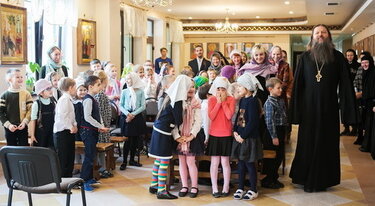
"In a time filled with sorrow, we Orthodox Christians proclaim a joy that comes from knowing God is with us. This joy — unshaken by life’s challenges — is at the heart of all we do, for we know that life does not end at the grave but points to our heavenly homeland.
With God’s blessing, may this gathering be a true celebration — a place where hearts are warmed and the faithful are strengthened."
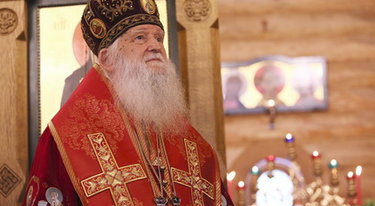
— Fr. Andrey Lemeshonok, addressing visitors at the Convent’s “Joy” festival
Sacred obedience, in Orthodox life, is not blind compliance but a free and mindful trust in God. It is the quiet art of letting His will shape our own, so that ordinary duties become prayer, service becomes healing, and craft becomes a living confession of faith. This series shares how that trust is learned day by day in our convent: at workbenches and meeting tables, in kitchens and workshops, wherever love and labour meet.
This time we step into the Exhibitions and Festival Office to meet its head, Nun Agapia (Knotko), and her close-knit team. Here, unity in Christ takes practical form as planning, hospitality, and creative work that have grown into the Joy Festival, now the largest Orthodox festival in Belarus, born of prayer, perseverance, and shared responsibility. Through their story of beginnings, trials, and traditions, we glimpse how togetherness becomes ministry and how joyful witness can take root in the heart of a community.
- Mother Agapia, do you remember how and when your obedience in the exhibitions office began?
My obedience at the monastery has remained the same from the start. I began working in the exhibitions office in 2008, back when I was still a layperson. Later, I joined the 'white' sisterhood, and some time after that, I took monastic tonsure.
I clearly remember how I came to work at the monastery. For about six months, I couldn’t find a job — nothing seemed to work out. Then a friend called me and asked if I’d like to help at the monastery. I went for the interview, shared a little about myself, and suddenly heard the words, “Come back tomorrow.” At that time, I had no connection to the monastery at all — I didn’t even attend services here. But everything changed quickly once I started working.
- What was the most difficult thing for you at that time?
Looking back, it feels like it was easier then than it is now — because grace covered everything. But still, I wasn’t an organiser by nature; I was more of a doer. Suddenly, I had to communicate with administration and clergy. That was the hardest part for me — overcoming fear and believing that God could work through me.
The first exhibition organised by our monastery took place in 2008. It felt like a wonderful “childhood,” filled with enthusiasm. We did everything with our own hands — the nuns baked pancakes, and I remember a terrible hurricane where we stood holding the tents to keep them from flying away. Among us was a sculptor, Ilya Kiryanov, who organised classes with children — they adored him and clustered around him like little birds. We lived in a small village house, and in the evenings, after a long day’s work, we would gather to sing songs together.

That time was marked by unity, friendship, and sobornost (conciliarity). The life I witnessed at the monastery during those years became the foundation of my decision to embrace monasticism. God was revealing the beauty of monastic life to me.
- You’ve remained in the same obedience for many years. Isn’t it difficult to work so intensively? “Burnout” is a popular term these days…
I’m not a fan of the term “burnout.” I think it’s really about losing the grace of God and growing accustomed to your blessings. When the initial grace fades, life becomes more prosaic — you grow lazy and start feeling sorry for yourself.
But then there are moments of inspiration, when enthusiasm returns. It’s a daily battle within yourself. When self-pity creeps in, you risk losing everything. That’s when I stop and pray, “Lord, I’m thinking and acting wrong. Please help me.” Life has its stages, its ups and downs, but the struggle continues.

And yes, sometimes it’s just plain fatigue. I think about our spiritual father, Father Andrey Lemeshonok, who used to hold meetings with every workshop and travel constantly. Now he focuses on the essentials — the Liturgy and confession. He once told us, “Hearing confessions is my life.”
For me, I find support in my team. It’s inspiring to see that same passion I once had in my colleagues. When you see sisters and brothers who are eager to work, it gives you the energy to “move mountains.”
Any significant effort requires collective support. What can one person do alone? A leader is powerless without a team, and a team cannot function without a leader. We all depend on each other. Togetherness is the foundation of our monastery.

- How do you find the right people for your team? What criteria do you use?
It’s God who brings the right people. There have been moments when I thought we should part ways with an employee who wasn’t fulfilling their duties. But the Lord intervened, and that person began to recognise their mistakes and change.
I see that God Himself gathers the people we need. Staffing is always a challenge, and I worry for my employees because they work so hard. Many of them have families, and after a long day here, they return home to their second job. I truly see their lives as a feat of dedication. But God rewards them with His grace.

- So, you would say the work requires full dedication?
Absolutely, but that’s true for any monastic workshop. If you want to strengthen your connection to the monastery, you must treat your work as a service, not just as a job.
- What traditions have developed in the office over the years? How do you build a strong team, and is it even necessary in an obedience?
Just recently, I was scolding everyone at a meeting, saying, “Duty comes before friendship!” (laughs). It’s important not to indulge one another but to support and help each other. If someone struggles to complete a task, don’t judge — step in and help. That’s what teamwork means.
“Christ is in our midst” — this phrase from the Apostle captures the ideal of Christian service. But it’s not easy to live by this law. In the daily grind of work, it’s essential to at least remain kind and humane — don’t point fingers, but take responsibility and support your colleagues.

Once a month, we take Communion together and share a meal. I remember one employee who was deeply upset when we introduced this tradition. He was a man with a difficult past, just beginning his journey of faith. Sadly, he is back in prison now, but he told me that receiving Communion back then changed his life.
Of course, we can’t force anyone to take Communion — it’s a personal choice. But it’s one of the conditions we make clear from the start: to work here, you need to participate in Communion. I don’t see how we can truly stay united otherwise. Only God can hold us together and keep us from falling apart.

- The Joy Festival is the main project of the exhibitions office and a very large-scale endeavour. How do you manage such a workload?
The Joy Festival is currently our primary project, and it requires tremendous effort and labour. Interestingly, when you feel like you’ve reached your limit and can’t do any more, you realise that in order for the work to grow, you actually have to take on even more.
- How would you define the concept of the festival? And what is most important to you personally about it?
It’s the largest Orthodox festival in Belarus, and we strive to show our guests the most beautiful, kind, and good things. We want everyone who comes to experience what joy means in Orthodoxy, as we understand it. After all, there are many kinds of joy.
We see the festival as a space where we can address the issues that concern people — family, societal problems, relationships, even the war in Donbass. We shouldn’t shy away from difficult topics; instead, we need to confront them with faith. The most important thing is that we look at these issues through Christ, through the lens of Orthodoxy. Yes, there are problems, but they are solvable — if we approach them with God.

- Some accuse the monastery of being too commercialised. How do you respond to this?
The monastery’s main goal is to serve people. Our exhibition stands are staffed by ‘white sisters’ whom we carefully select. Their role is not just to sell products but to reflect God’s light. The goal is for anyone who interacts with them to feel inspired to come to church.
That’s the motivation behind our work. I have no interest in mere commercial activity — it wouldn’t resonate with me. I know that everything earned here goes toward serving people: supporting our farmsteads and hospitals, building churches, and funding projects like “The Ark,” our convention centre, which has already become a key venue for engaging with young people. I’m ready to dedicate my efforts to such purposes. But working just to make money? That would be meaningless.
It’s also important to note that the monastery provides opportunities for many people who struggle to find work elsewhere — those with addictions, mental illnesses, or past convictions. Society may have written them off, but here they find dignity and purpose.
I do understand why some people feel hurt or disappointed. They see the flaws in the Church — sins and failings that are real and cannot be denied. The Church is a living organism, made up of ordinary people, and sin clings to everyone, whether they’re a priest, a nun, or a layperson. Those on the outside see these sins and lose faith. We are guilty of this — we fail to resist sin as we should.

- Would you say that all the monastery’s projects are intended as stepping stones to faith?
That’s our most important goal. I’m wary of loud statements, but I truly hope our work can serve as a stepping stone for someone to come to the Church. I know how hard it can be to take that first step — I remember it from my own experience.
Sometimes, a small connection can make all the difference. For example, someone might visit a festival, buy a beautifully crafted cup, and start wondering, “What kind of monastery is this? Who are the people who work here?” That curiosity might plant a seed that grows over time.
- This Christmas Festival will feature some interesting guests. How do you choose who to invite?
While we set themes for the festival, I believe the Lord ultimately directs everything. Sometimes, despite our best efforts to invite someone, it just doesn’t work out — there’s no blessing. Other times, a very busy guest might agree immediately. It’s clearly God’s guidance.
We often discover potential guests through blogs, radio, or Orthodox magazines. We also arrange meetings with them at The Ark, our convention centre.
- What is most important to you personally in the cultural programme of the festival?
Everything matters. The children’s programme, the meetings with priests and inspiring individuals, and the opportunity to host guests from churches and monasteries across different cities and countries — all of it is significant.
A special place in the festival is reserved for our charity efforts. For example, the “Help to Brothers” campaign for the people of Donbass has become a tradition. Visitors can contribute by leaving donations or writing letters of support. Volunteers from our monastery have been travelling to Donbass on humanitarian missions almost every month since 2014.
We also have a Christmas tree adorned with wishes from children in Donbass, which our visitors help fulfil. This year, we’re also planning a fundraiser for the restoration of churches in the Donbass region.
- Mother, what brings you personal joy in your obedience?
I find joy in seeing people who are willing to listen to and help one another. Conflicts are natural, but what matters is that we hear each other and forgive.
Metropolitan Philaret (Vakhromeev) once said, “The atmosphere in your monastery will determine what happens in Minsk.” But the monastery is not just the nuns. It includes the Sisterhood of Mercy, the brothers and sisters at the farmsteads, and everyone in the workshops. None of our work will bear fruit if we fail to share this unity within the monastery.

Interviewer: Maria Kotova
Photos from the Monastery’s Archive