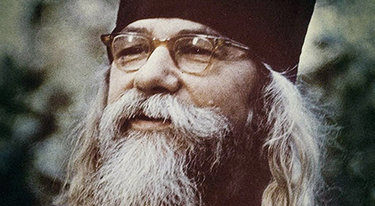
I was deeply struck by Elder Paisios of the Holy Mountain's words about meals. He came from a traditional Greek family - father, mother, and seven children. They always ate together, waited for one another, and did not begin until all had gathered around the table. If someone ate separately from the family, it was seen as a betrayal of their unity. Elder Paisios shows how important it is for a meal to be shared.
A family is a little Church, and one should approach a meal not only as physical nourishment, but also as a continuation of the Divine Liturgy. One should come to the family table with reverence. Before the meal there should certainly be prayer together - in this lies the deep meaning of our unity with one another and with the Lord.
In our family, if one of the children is fooling about before the meal, their father may simply not allow the child to sit down at the table until he has calmed down and prayed. For the youngest, it is enough simply to help him make the sign of the cross, after which he says, "Amen." That is his prayer. It matters greatly that he should feel some measure of responsibility before the meal.
If the children disobey and behave badly at table, they usually do not receive sweets afterwards. They drink fruit drink and tea, but without sugar.
We have a custom in our family: a sweet must be earned - by reciting a poem or singing a song. Then the whole thing turns into a real concert. Sometimes their father even says, "I've heard that one already - prepare something new." The children try very hard: they sing, they recite poems. It makes for a beautiful meal.

Still life
You can also give a meal a festive note by lighting candles. When a candle burns on the table, one does not want to talk about trivial things. Then quiet comes into the soul, and into the heart - peace and tenderness.
Metropolitan Anthony of Sourozh put it beautifully: food, what we eat, is also the love of God. I was also struck by an example someone gave of a monk eating rice. He ate slowly and calmly, and took each grain with such gratitude, as though he were praying with a prayer rope, saying the Jesus Prayer over every one.
Of course, we do not manage, as in Elder Paisios's family, to have all three or four daily meals together, because my husband is often busy, and it is a real celebration for us if he has supper with us. Usually our meal goes like this: we pray, sit down, and put on readings from the lives of the saints on the cassette player, almost as in a monastery. The children do not talk at the table. And, of course, after eating we pray again, because if you do not pray afterwards, you usually feel that something is still lacking.
It is better, after all, when there are no in-between meals, no constant snacking. We pray, eat the first course, the second, the third, perhaps have a biscuit or a sweet - and that is all. If a child has behaved well, then he gets his sweet and that is the end of it: the next meal is several hours later. It is much like a monastery: twenty minutes and no more, because if one begins to relax, that is no help either. Even from the point of view of dental health, the acid-alkaline balance in the body should not change too often. Teeth suffer from that. No more than six times a day - that means three main meals and two light meals or snacks. Sweets too are best given to children only after the main meal. I have noticed in many families that children come into the kitchen, eat a biscuit or a sweet, and then, of course, even an hour later they do not want dinner.
It once occurred to me that teeth are spoiled not only by food, but also by empty phrases and unseemly words - that is, by idle talk. Perhaps that is why my own teeth are crumbling: because I am such a chatterbox.

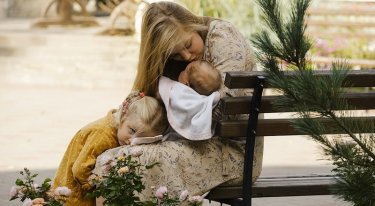
Family at table
In fasting, of course, the example of the parents matters enormously, because if the parents do not fast, the children certainly will not. For children, the authority of their parents comes first.
For our children, fasting means only giving up meat. We keep dairy products and eggs in their meals. The children accept such limits calmly, though even so they say, "When I grow up, I'll fast like Dad too."
Children notice everything, and they also see that there are families where no one fasts. That naturally raises the question: "Why do other people not fast, while we have to?" Then one has to talk and give examples. Once a priest in Kruptsy said to me, "If you do not fast, the Catholics will come..." Perhaps I did not understand him quite rightly, since I know church history very poorly, but I think he meant that when people begin to allow themselves spiritual slackness, other things soon follow.
It is good to explain everything to children through examples. In our history and in the lives of the saints there are many such examples.
Our little David is very keen on knights, heroes, and battles. In the history of ancient Rus', there were times when an enemy marched against the land and a three-day fast was imposed on whole cities. By such simple examples much can be explained. Here is Saint Mary of Egypt - our little Masha's saint. And you tell them that for forty-seven years she ate almost nothing, prayed, and the Lord sustained her. One must tell it in a child's way, with love - not so that they stop eating altogether, but so that they may see what beauty there can be in repentance, fasting, and prayer.

Family in church
Of course, there are children who eat almost nothing at all. For children with poor appetites, fasting may be no problem. But our children, thanks be to God, have healthy appetites. And besides, if one gives up meat, one can always find an alternative: the choice of fasting foods is now wide.
I often like to cook something tasty, to enjoy it, and be glad of it, but during a fast that is no longer part of our life. During the fast we do not watch cartoons. If the fast falls in summer, we do not go to the park or look for other amusements. At all times we try to limit sweets.
For every fast my husband and I ask a blessing from our priest. Each time he blesses us differently. Only now and then has he blessed me to keep the fast in the full way, because I am usually either pregnant or nursing. Once he blessed me to fast without meat and dairy. I had not expected that at all - I thought he would bless a lighter fast - but he said, "Keep the fast, and afterwards you will receive a gift from God."
It was very hard to fast, because I had already grown slack and was not ready for it at all. I expected that at Pascha there would be some sort of prize for me from the Lord. But Pascha Sunday passed, and I said to my husband, "Well then, where is my gift?" And Seryozha answered, "There's still a whole week ahead. Your gift will come." Bright Week passed, and still there was no gift. Exactly half a year went by, and then it dawned on me. During Bright Week we had begun to sort out our housing problem. Before that we had rented a flat, and then Seryozha took out a loan and we bought it. And then I saw it - a whole flat as a gift. Just think of it. I had kept the fast. I remembered too that before my milestone birthday Seryozha had asked, "What shall I give you?" and I had joked, "Either a flat or a car." Of course I was joking, because I knew such gifts were beyond us. Only half a year later did I understand that this had indeed been the gift from the Lord.

Let me tell one more story. For a long time I could not wean little David. Even when Elisha was born - and he was born two years after David - the elder boy still did not want to give up his milk meal. It was very hard for me. But the priest blessed me to go on feeding him. I often spoke about it in confession, and he would say, "Bear it, bear it - the time will come." I waited for that time for a very long while.
Then came the Dormition Fast. Of course I thought that once again I would keep it in a lighter way. But it turned out that Seryozha went to the priest, and the priest said, "Let her keep a stricter fast, as is proper. This is a women's fast, and it is such a short one..." I was not ready for it at all. "Well then," I thought, "what can one do? In the end, two weeks will pass quickly." And as soon as I began to fast, a thought came to me: "I do not want to give up cow's milk, and my child does not want to give up my milk." And after the feast of the Dormition of the Most Holy Mother of God, little David gave up his mother's milk completely.
Last Great Lent I was already pregnant with Vasilissa and was nursing little Elisha, and he developed an allergy to sweets, to sugar. Since it was easy enough for him not to have sweets - he was feeding on breast milk - I too had to give up sweets. I have such a sweet tooth, and what a trial that was. But the Lord helped again. At Pascha both the little one and I ate sweets, and there were no clear signs of allergy. Before that, little Elisha had been covered in red spots, like a tiny leopard. After that fast, thanks be to God, it all passed. Though it was very hard. It is easier not to eat meat than not to eat sweets. Still, with God's help we managed. And the greatest comfort, of course, is that time passes quickly. When fasting is hard, time flies.

Bread on the table
For children, getting used to fasting comes little by little. For example, in our family, if I cook Lenten dishes for Seryozha and myself, then naturally I do not need to cook a separate meal for the children. The only thing is that I may add a little sour cream to their borshch, or put oil into their bowls rather than into the pot. I think our children do not find fasting very hard. One must certainly look at the circumstances, because Masha is six, while Elisha is only one year old.
On the whole, I think the most important thing is to give them the sense that fasting is joy. Because when I had the chance to fast in the full way, I remember what bright thoughts came. When one has little strength, one does not say anything unnecessary, and if one does speak, it is only to the point. When I tell the children about fasting, I try to reveal its beauty to them through examples.
And one thing matters greatly here: when you tell children about the feasts of Saint Mary of Egypt, Saint Eudoxia of Moscow, Saint Sergius of Radonezh, and other ascetics, you must speak with joy. If they see joy in you, that will be the best way to explain to them the aim and meaning of fasting. For fasting is a needful means for our sanctification and union with God. And meeting God and being one with Him is the most joyful thing in life.

And here is one more example. We have an aunt. She is not a church-going person and, of course, does not fast. Once, at Christmas, relatives came to stay with us. They had been celebrating everything - Christmas, both Catholic and Orthodox, and New Year. We, of course, laid the table and waited with trembling, thinking that now we would taste all these good things - for us, after the fast, it was an exquisite table. But our Aunt Olya said, "Yes, that is exactly why it is so good for you. What joy this is for you - whereas for us it makes no difference, because we eat this all the time and see no feast in it..."
Thanks be to God, in our family everyone goes to Holy Communion fasting, even the babies. The Lord orders things so that they do not even drink water. Seryozha is strict about this, and so the children keep it calmly as well. If the service goes on until half past eleven, that means they take nothing until twelve.
I also remember how Elder Paisios said that when children are playing, they do not want to eat. He gives an example from his own childhood, when children in Great Lent received Holy Communion at the Liturgy of the Presanctified Gifts. Their parents went off to work, shut them in some sort of enclosure, left them toys, and then came back at three o'clock and took them to the liturgy. During that time the children played and did not ask for food.

It is the same with us sometimes: when little Elisha wakes on Sunday morning, he walks straight to the kitchen, so we dress him quickly, and Seryozha takes him outside before anyone else gets up, so that he can play. Then he forgets about food. And so we live.
Glory to God for all things!
By Sister of Mercy Nadezhda Kuptsova