We live in an age of shortened horizons. Our days are measured by headlines and markets, by the private terrors that wake us before dawn – illness, children, loneliness, the future. Everything feels heavier when the soul has nowhere farther to look.
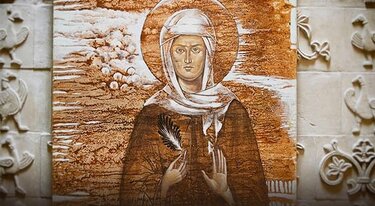
A century ago, in a Russia coming apart under revolution, St Elisabeth Romanov met a far more violent version of the same human condition. Yet those who knew her remembered stillness. Metropolitan Anastasy found the image for it:
“It seemed as though she stood upon a high, unshaken rock, and from there looked without fear upon the raging waves around her, fixing the eyes of her spirit on the eternal distances.”
What was the rock beneath her feet? And could it still be found beneath ours?
Orthodoxy gives that rock a name. It is the knowledge that this life is not the whole of life, that we are not settlers here but pilgrims. St Elisabeth spoke of that truth with disarming clarity:
“We are strangers and pilgrims on the earth. This visible world is but the place of our sorrowful exile. Earthly days are full of deceit. For each one there comes the hour when he must go home, to the Heavenly Fatherland. God’s holy ones await death as the greatest joy. For them, the end of earthly life is the meeting with the Creator, to Whom the soul had ceaselessly reached out. A person who has given himself to God believes that the Lord watches over him in all things. Trusting in God’s saving Providence, he bears every pain and sorrow.”
Out of that vision came one of her simplest sayings:
“The Lord is watching over me; what have I to fear?”
This was not the calm of someone spared grief. By then she had already buried her husband, Grand Duke Sergei Alexandrovich, killed by an assassin’s bomb in Moscow. Her fearlessness came from knowing, with a child’s certainty, where home was.

An eternal horizon can sound like a retreat from the world. In St Elisabeth, it had the opposite effect. The farther she looked, the more fully she remained.
A witness recalled her this way:
“With courage and calm the Grand Duchess met the turmoil that had begun in Russia. As before, she helped people: she visited the wounded and took part in organising aid for the front. There was not the least trace of bitterness in her. “The people are but children; they are not guilty of what is happening,” she said gently. “Is it not a sick child, whom we love a hundred times more in his illness than when he is cheerful and well? One longs to bear his sufferings, to teach him patience, to help him…””
She was speaking of the very people among whom the violence was spreading, the same world that would soon kill her. Yet she spoke without anger. She saw a people in fever and loved them more for their suffering.
More than once, she was given the chance to leave Russia. She refused.
“Having come to love the Russian people with all her heart, she resolved to share their sufferings to the end, and refused to leave Russia. With clear sight she wrote that the gates of hell would not prevail against the Orthodox Church, that our Intercessor, the Most Holy Mother of God, would entreat Her Divine Son, and that the Church would remain, having passed through every trial.”
The source of that firmness appears in her own words:
“…If we come to know that great sacrifice of God the Father, Who sent His Son to die and rise again for us, then we shall feel the Holy Spirit near, Who gives light to our path. And then joy becomes eternal…”

So when martyrdom comes, it feels less like an interruption than an unveiling. From the outside, tragedy descends on a holy life. From within, the life seems to have been moving quietly in this direction all along.
A contemporary reflection describes that mystery:
“God’s Providence is beyond our knowing. When the soul grows strong and becomes able to go where suffering awaits, then the trials begin. The Lord leads a person to that cross which his soul can bear; He leads him to the line beyond which eternity begins. By a narrow and bitter road He leads him to immortality, to holiness, to victory over death.”
Even the day of her arrest bore the mark of Pascha:
“In April 1918, on the third day of Pascha, Elizaveta Fyodorovna was arrested and taken from Moscow. On that day His Holiness Patriarch Tikhon served the Divine Liturgy and a moleben at the Martha and Mary Convent. This was a blessing and a parting word for the Grand Duchess before her way of the cross to Golgotha.”
Her farewell to the sisters sounded in the same key:
“Lord, bless us. May the Resurrection of Christ comfort and strengthen you all… Draw close together and be as one soul, all for God, and say, with John Chrysostom, “Glory to God for all things!””
And then, as she was taken into exile:
“Thus the Great Mother gave her parting word to the sisters as she went into exile. Trees flashed by the carriage window, clouds drifted low, and all was merging into one…”
“And now the road was at an end. My son, give me your heart…”
The way of the cross had already begun.

The account of her death is brief, and that brevity is part of its power:
“On a deep July night, on the day of the uncovering of the relics of Saint Sergius of Radonezh, the Grand Duchess, together with the nun Barbara and the other prisoners, was thrown into a mine shaft. They say that from the depths the Cherubic Hymn was heard. Hosts of Angels took it up in reaches unseen by earthly eyes, where nothing can any longer rob the soul of eternal joy.”
A woman is murdered by her century, and from the pit rises the song of the Church. It is hard to imagine a more Orthodox image of martyrdom: worship carried through darkness into the life of the world to come.
The horizon by which she had lived was no longer distant. She had not been walking toward an abstraction. She had been walking toward Christ.
All things are bound by the pledge of earth –
Night for the beast, wide space for the white bird;
But who will hide beneath that whiteness?
Who will make defence for the Angel?
There are none in the world more defenceless than they.
There are none more hidden in this cold world.
Before them lamps must be lit.
They must be sung on the loudest lyre.

Then, almost unexpectedly, the story turns tender.
Years earlier, while on pilgrimage to the Holy Land, St Elisabeth visited the Church of St Mary Magdalene at the foot of the Mount of Olives. Looking about her, she said simply:
“How I should like to be buried here.”
It is such an ordinary sentence, so light and passing, that it might easily have vanished. But the biographer adds:
“How wondrous it is that God hears every word.”
And in time – after revolution, exile and death – that passing wish was fulfilled:
“The relics of the abbess of the Martha and Mary Convent and of her faithful cell-attendant, the nun Barbara, were taken to Jerusalem and laid in the crypt of the Church of Saint Mary Magdalene, Equal to the Apostles. When the coffin holding the Grand Duchess’s body was opened, the room filled with fragrance. In the words of Archimandrite Anthony, there was “a strong scent, like honey and jasmine.””
A sentence spoken on a bright day, remembered by God across catastrophe. The Church now addresses her in words that gather all this into praise:
“Rejoice, you glorified by the unsearchable judgments of God.
Rejoice, blessed dweller in the heavenly Jerusalem;
Rejoice, you who lead us all to the Jerusalem above.”
From the Akathist to the Holy Martyr St Elisabeth

If her death has the still radiance of an icon, her letters have the warmth of a lamp-lit room. Their power lies in tenderness. She writes from within loss and uncertainty, yet what comes through is attention: to faces, to weather, to prayer, to small practical matters, to the souls entrusted to her care.
She writes:
“Lord, bless.
May the Resurrection of Christ comfort and strengthen you all. At six o’clock we passed Rostov, and in the evening the Trinity-Sergius Lavra… May Saint Sergius, Saint Demetrius, and Saint Euphrosyne of Polotsk keep us all, together with you, my dear ones. We are travelling very well. Snow is everywhere. I cannot forget yesterday, all those dear, beloved faces. Lord, what suffering there was in them; oh, how my heart ached. With every passing minute you all became dearer to me still. How am I to leave you, my little children? How am I to comfort you, how am I to strengthen you? Remember, my dear ones, all that I told you. Always be not only my children, but obedient disciples as well. Draw close together and be as one soul: all for God – and say, with John Chrysostom: “Glory to God for all things.””
“I shall live in the hope of being with you again soon, and I long for all of you to be together when I find you. Read together, not only the Gospel, but the Epistles of the Apostles as well. Elder sisters, gather your sisters into one. Ask Patriarch Tikhon to take the ‘little chicks’ under his wing. Set him in my middle room. My cell is to be for confession, and the large room for receiving visitors. If there is no delay anywhere, we shall arrive only on the fifth day. Ekaterina will return to you as soon as she can, and she will tell you everything, how we have settled.”
The details make the letters unforgettable: snow beyond the train window, saints named one by one, rooms assigned for confession and visitors. The holiness here has texture. It is domestic, liturgical, maternal.
In a later letter, eternity comes through still more clearly, yet the voice remains unmistakably her own – steady, affectionate and free of self-dramatising:
“My dear little children, glory to God that you received Communion: as one soul you all stood before the Saviour. I believe that on this earth the Saviour was with you all, and at the Last Judgment this prayer will again rise before God as mercy towards one another and towards me. I cannot tell you how deeply your letters moved me and gladdened me. You wrote to me that every one of you, without exception, would seek to live as I so often told you.”
“Oh, how you will now grow in the work of salvation! I can already see a good beginning. Only do not lose heart and do not grow weak in your bright intentions, and the Lord, Who has parted us for a time, will strengthen you inwardly.”
“Pray for me, a sinner, that I may be worthy to return to my little children, and may grow better for your sake, so that we may all think of how to prepare for eternal life.”

“Now we are all passing through the same thing, and without willing it we find comfort only in Him, that we may bear our common cross of separation. Our Lord has seen that it is time for us to bear His cross. Let us seek to be worthy of this joy. I thought that we would be so weak, not yet grown enough to bear a great cross. ‘The Lord gave, and the Lord has taken away; blessed be the name of the Lord.’ As it pleased the Lord, so it has come to be.”
“What an example Saint Job gives us by his submission and patience in sorrows! And after that the Lord gave him joy. How many such examples of sorrow there are among the holy fathers in the holy monasteries, and afterwards there was joy. Make ready for the joy of being together again. Let us be patient and humble. Let us not murmur, but give thanks for all things.”
“The grace of our Lord Jesus Christ be with you, and my love be with you all in Christ Jesus. Amen.”
“Your constant prayerful one before God, and loving mother in Christ, Mother.”

St Elisabeth’s life presses gently, insistently, against the habits of feeling by which we live. Hope did not remove her from the world; it made her capable of staying. It did not cool her love; it gave it patience. It did not spare her suffering; it placed suffering beneath a larger sky.
That is why her words do not feel like relics from 1918. They give anguish, confusion and loss a horizon. They remind us that the soul need not live at the mercy of whatever presses nearest.
Perhaps that is the unshaken rock after all: the knowledge that grief and danger are not final, because Christ is beyond the storm and already near.
“Rejoice, you who lead us all to the Jerusalem above.”
Holy Martyr St Elisabeth, pray to God for us!