Born into a noble family, Saint Germanus chose the monastic life instead. As abbot and later as bishop, he became known for ascetic discipline, pastoral courage, mercy to the poor, and tireless care for the Church. He founded the monastery later known as Saint-Germain-des-Prés, which soon became one of the great centres of religious life in Paris. He took part in church councils, defended the purity of Christian teaching, and worked for peace in the divided Frankish kingdom. After his death, his relics were associated with many miracles.

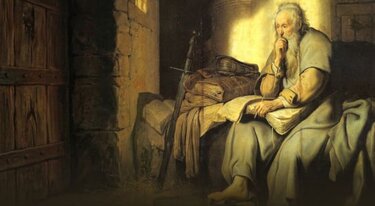
As abbot, Germanus was severe in his self-denial. His discipline sometimes irritated the bishop, and on one occasion the tension between them led to his imprisonment. By tradition, the doors of the cell opened by themselves, giving him the chance to leave. Germanus, however, refused to go until he had been formally released.
Around 555, King Childebert called Germanus to Paris and supported his appointment as bishop. The new office did not alter his way of life. He kept his plain clothing, his simple habits, and his monastic discipline. Even as bishop, he remained an ascetic, seeking to live the angelic life.
Germanus devoted himself to the salvation and care of his flock. According to tradition, his preaching was accompanied by the gift of miracles. Through his prayers the sick were healed, the lame walked, and those afflicted by evil spirits found relief. He would sometimes keep the sick and suffering near him for several days, praying over them until they were restored.

News of these gifts spread widely. Objects blessed by Germanus, or even touched by him, were given to the suffering, and many were healed through God’s mercy. He distributed church money freely in alms, and when the funds ran low he asked King Childebert for help. The king came to respect him deeply, especially after Germanus healed him of a serious illness.
His mercy extended to all: the devout and the wayward, the powerful and the poor. Whenever he could, he secured the release of prisoners and bought the freedom of slaves from many nations. The Christians of Paris came to see him as a new protector of the city, recalling Saint Denis, who is commemorated on 9 October.
Germanus also worked to strengthen the liturgical and spiritual life of the Church in Gaul. He encouraged the veneration of local saints and took great care over the beauty and dignity of divine services. Several features of the old Gallican, or French, rite came to be associated with his pastoral and liturgical work. With the king’s support, he founded the Monastery of the Holy Cross and Saint Vincent, later known as Saint-Germain-des-Prés.

For the new foundation, Germanus drew on the monastic tradition he had known at Saint Symphorian and on the customs of the renowned island monastery of Lérins. As a guardian of church tradition, he worked for unity and peace within the Church of Gaul. His authority helped settle disputes at the Council of Tours in 566. He also convened two councils in Paris, in 557 and 573.
When Childebert died in 558, Paris became the capital of the united Frankish kingdom under Chlothar. Chlothar, too, came to respect Germanus, encouraged in part by his wife, Saint Radegund, who is commemorated on 13 August. When Radegund chose to become a nun in the Monastery of the Holy Cross, which she had founded in Poitiers, Germanus persuaded the king not to stand in her way. He later continued to support her with pastoral counsel.
Chlothar’s reign was brief. After his death in 561, the kingdom was divided among his sons: Charibert, Guntram, Sigebert, and Chilperic. Charibert, King of Paris, soon came into open conflict with the Church. He seized church property and entered into unlawful marriages, including one with his wife’s sister. When Germanus excommunicated him, the king mocked the penance. Soon afterwards, however, God struck both Charibert and one of his wives dead.

Germanus also tried, unsuccessfully, to halt the violence caused by the rivalry between Brunhilda, wife of Sigebert, and Fredegund, wife of Chilperic. After Fredegund arranged the murder of Brunhilda’s sister in 575, Sigebert went to war against Chilperic. As Sigebert entered Paris, Germanus met him and warned him against revenge, quoting Scripture: "Whoever digs a pit will fall into it." Sigebert ignored the warning and was later killed.
After many years as bishop, peacemaker, defender of the faith, and shepherd of his people, Germanus reposed peacefully on 28 May 576. He was buried in the church of his monastery in Paris. During the great fire of 585, tradition says that he appeared to prisoners held in the city and freed them; they then took refuge at his tomb. His relics continued to be venerated, and many miracles were attributed to his intercession.

Saint Germanus was added to the calendar of the Russian Orthodox Church by the Holy Synod on 9 March 2017, journal no. 14.
Source:
Hieromonk Makary of Simonopetra, Synaxarion: Lives of the Saints of the Orthodox Church, 6 vols., adapted from the French, Moscow: Sretensky Monastery Publishing House, 2011.