Nothing concerning the Church can ever be resolved by compromise; between truth and falsehood, no middle ground exists.
— Saint Mark of Ephesus
Living today, in what Archimandrite Ambrose (Pogodin)* rightly termed "an era of moral compromise," many find their minds and hearts crying out in the daily battle to keep their faith alive and remain true to God. This struggle may lack the dramatic brilliance of the ancient saints, yet it matters deeply — for our own salvation and, often, for those around us. Increasingly prominent in this modern quest stands the humble figure of Saint Mark of Ephesus. Of him, the Synaxarion for 1 February declares: "Atlas bears the heavens on his shoulders in ancient myths; Mark bears the Orthodox faith — not in myths, but in reality."
Saint Mark lived in the fifteenth century, four centuries after the tragic split between the Roman Catholic and Orthodox Churches. During those intervening years, Catholics had introduced several new doctrines considered by Orthodox theologians to be contrary to those established by the Ecumenical Councils. Chief among these stood the Catholic beliefs that the Holy Spirit proceeds not only from the Father but also from the Son (the Filioque), the teaching about purgatory, and, most notably, the notion of papal supremacy over all other local Churches.
Meanwhile, the Byzantine Empire was worn down by constant battles with the Ottoman Turks. In this desperate hour, an idea took root among the Byzantine nobility to seek aid from the Pope of Rome. In response, the Pope proposed holding a council in Italy to unite Christendom and jointly defend against advancing Muslim Turks.
The Emperor and the hierarchs of the Church of Constantinople accepted the Pope's invitation. Yet once at the Council, events took a turn quite different from what the Greeks had anticipated. Standing alone amongst the Orthodox representatives, only the Venerable Mark of Ephesus held firm to the Church, firmly rejecting all compromises — political or doctrinal.

A reconstruction of the Mangana quarter in Constantinople
Our story begins in 1392, in the Galata district of Constantinople, with the birth of a boy into a noble and devout family. His father, George, served as a deacon and sacellarius at Hagia Sophia Cathedral and taught at a local school; his mother, Maria, was the daughter of a respected and God-fearing physician. At baptism, the future saint received the name Manuel. From the very start, his parents ensured that he and his brother John received a superb education.
Manuel’s father, his first guide in learning and faith, died when the boy was just thirteen. Though orphaned early, Manuel — as John Eugenikos records in the Synaxarion — "refused to let himself grow idle but chose instead to seek out the finest and most celebrated teachers. He first studied under John Hortasmenos — who later graced the throne of the Metropolitan of Silivri — and Ignatius Metakliphis. Afterwards, he turned to renowned philosophers and mathematicians such as Gemistus George. Through tireless effort, meticulous attention and an extraordinary intellect, Manuel swiftly acquired great knowledge. Then, with a holy character — gentle, dignified, and fitting for an elder — his manner of dress, footwear, gaze, the tilt of his head, and his polished, refined speech — he was a marvel not only for his fellow students but also for the teachers themselves and indeed for all. Thus he spent his childhood beautifully and devoutly, excelling wonderfully in all good works..." Soon enough, this gifted young student became a teacher himself, stepping into his father's role and attracting some of the city's brightest youth. Among those who studied under him and went on to become notable were George Scholarius and Theodore Agallistes.
By now, Manuel was a young and highly educated cleric. He had stepped into his father’s role at Hagia Sophia in Constantinople, living a life of rare discipline and spotless integrity. Reflecting later on this period of the saint's life, Gennadius Scholarius said in his funeral oration: "Even as a young man, before he began disciplining his body for Christ's sake, he surpassed desert hermits in righteousness. He renounced all worldly pursuits for Christ alone and willingly embraced obedience to God. Never did he stray from this path; never did he succumb to worldly pride or become tempted by fleeting fame. Until his final breath, he preserved an ardent love for Christ."
Although he lived in the capital, he remained a stranger to its ways, for nothing bound his heart to it. Much respected by all, he never sought honour; in truth, he wished none of it.

Monk Mark arrived on the island of Antigone in the company of his spiritual father, Abbot Simeon.
A soul as noble as Manuel's could hardly pass unnoticed. He soon became a favoured spiritual son of Euphemius, Patriarch of Constantinople, and after the patriarch's death he composed a canon and stichera in his honour. Emperor Manuel II himself drew him into his inner circle, making him a trusted confidant and adviser. Yet despite these bright prospects, the future saint chose instead the quiet solitude of Antigone, a small island in the Sea of Marmara. At twenty-six, he withdrew there with his elder, Abbot Simeon, taking monastic vows with the name Mark.
Their life of prayer and solitude, however, was not to last. The ever-present threat of Turkish raids forced them back to Constantinople, where they took up residence in the Mangana Monastery of the Great Martyr George. Here Abbot Simeon ended his earthly journey; here too, after a life nobly lived, Saint Mark himself would later be laid to rest. When the elderly Metropolitan of Ephesus, Joasaph, reposed in 1437, the Church called upon Mark to take his place. He accepted this duty out of obedience to the Church, much against his wishes.

Ancient Ephesus
Saint Mark longed for the quiet ascetic life of solitude and silence that had once drawn Saint Gregory the Theologian. Instead, God’s providence called him to a bitter struggle, amid ecclesiastical and political scheming. Instead of peaceful solitude, Saint Mark was forced to speak with fire, to marshal careful argument and relentless logic in defence of Orthodox teaching, reproaching error where he found it.
From a sheltered life of prayerful retreat, he was thrust into a stormy sea of passions and disputes, threats and persecution, apostasy from Orthodoxy and betrayal of truth — all swirling around him. This storm had a name: the Union of Florence. Saint Mark's heart desired one path; God and the Church required another. To his learning, wisdom, and ascetic virtue, God added the crown of fearless witness.
Throughout its thousand-year history, the Orthodox Church has had to stand firm against a world that always tries to bend it to its will. For believers, such times bring trials, worries and sorrows. Yet they also reveal genuine lights of faith among Christians — those willing even to give their lives for Christ and His Church.
Just such a man of faith was Saint Mark, Metropolitan of Ephesus.
For Saint Mark, the unity of the Church in Christ was a gift from God, preserved only by observing collegiality in church leadership. The Ecumenical Councils represented this principle best. Saint Mark saw collegial governance as fulfilling Christ's commandment to love one another; without this love, the divine gift of peace could not last. From his perspective, papal supremacy was more than just a departure from historical tradition — it was an institutionalised sin. The council, then, became a kind of shared spiritual discipline, a way to overcome this sin's effects and restore Church unity.

Florentine Council, collage
At the Council, Saint Mark faced enormous pressure. Pope Eugenius IV, Byzantine Emperor John VIII Palaiologos, Patriarch Joseph II of Constantinople, Metropolitan Isidore of Kiev — all pressed upon him. He engaged in debates with Cardinal Cesarini and the Dominican Giovanni di Montenero, and answered speeches by the likes of Andrew Chrysoberges — all the while feeling the immense weight of responsibility before God, the Orthodox Church, and the faithful.
The Ferrara-Florence Council opened on 9 April 1438. It fell to Metropolitan Mark to be the voice of Greek theology before the Catholics. By then, almost four centuries had passed since the Latin Church had split from the Universal Church. The Byzantines still carried fresh memories of Constantinople's destruction by Western crusaders, the desecration of Orthodox shrines, and the persecution of the Church. Yet hope remained that Western Christians might return to Orthodoxy. "I followed the Ecumenical Patriarch and our God-given King and Autocrat to the Council in Italy," Saint Mark wrote, "despite my weakness and despite the great difficulty of our task, trusting in God and in the mutual Prelates. I believed everything would turn out well for us, that we would accomplish something great and worthy of our labour and hopes.”
He genuinely anticipated a historic turning point. He wanted, above all, to heal the schism by addressing the departures from Orthodox doctrine that had crept into Catholic theology. But as debates dragged on, it became clear that the Council was little more than a front for deeper political games. The Emperor desperately needed an alliance; the Pope demanded obedience from all Eastern Churches. The Catholics had no intention of openly discussing the real differences on matters of faith.
Venerable Mark soon understood this, but he was not about to give in. He pored over Latin theological works, carefully noting where they clashed with the decrees of the great Ecumenical Councils, or even where simple printing mistakes had distorted core beliefs. Later, at Council hearings, he raised these points openly. He systematically challenged doctrines accepted by Rome which conflicted with the Church’s tradition, calling upon the Pope to acknowledge these issues and put them right. He quoted from the Ecumenical Councils — many, it seemed, completely unknown to the Catholic scholars present.
Yet all the efforts of this eloquent writer, gifted theologian and remarkable speaker came to nothing. At the Council of Florence, no one truly sought the truth. Bogged down in fruitless arguments, the Council went on and on. Saint Mark himself later recalled: "Once again I debated with them, clearly showing how absurd their teachings were and proving their books had been dishonestly altered. Yet I achieved nothing. I convinced nobody. All I did was waste my time."
Pope Eugenius IV threatens the Metropolitan Mark of Ephesus with torture for his unwavering stance. The holy bishop remains calm and trusts in God.

The Face-Side chronicle of Ivan the Terrible** 1565–1576, Manuscript Department, Library of the Academy of Sciences
The Emperor, however, needed Western help against the Turks, and this union was the price. And so, on 5 July 1439, he and the Patriarch pressured the Orthodox bishops into signing the Council’s decree, the ‘Oros’, which sealed the Union of Florence. The Oros accepted Catholic teachings as truth, and the Orthodox Churches fell under Rome's control. Patriarch Joseph II, after signing the Oros and agreeing with the Filioque clause, died only days later. Several bishops refused to sign. Among them were Metropolitan Mark of Ephesus; Metropolitan Gregory of Iveria from Georgia, who feigned madness; Metropolitan Isaiah of Nitria; Patriarch Sophronius of Gaza; and Bishop Isaia of Stauropolis.
When Pope Eugenius IV received the signed act of union, he asked only one question: "Did Mark sign?" Hearing that Metropolitan Mark had refused, he exclaimed: "Then we have achieved nothing!" Because of his firm defence of Orthodoxy, Saint Mark faced persecution, arrest and two years in prison. Yet he bore it all, staying true to Holy Orthodoxy.

Places where Saint Mark of Ephesus performed his spiritual labours during his lifetime
Back in Russia, the union was rejected — even though Metropolitan Isidore, a Greek appointed by the Patriarch of Constantinople to lead the Russian Church, had signed it at the Council.
When Isidore returned to Moscow, now as a cardinal and envoy from the Pope, bearing a Catholic cross, the shock was instant. At the very first liturgy, he named the Pope as head of the Church and read aloud the decree of union signed at the Council of Florence. The people stood dumbfounded. First to regain his composure was Grand Prince Vasily Vasilyevich II, who denounced Isidore as a "heretical deceiver," a "ravenous wolf," a "false shepherd," and a "destroyer of souls." He swiftly arrested him and had him locked away in the Chudov Monastery. Three years later, Isidore escaped and fled back to Rome. The prince, however, had not guarded him particularly closely, and when Isidore vanished, Vasily thanked God that divine mercy and the Holy Mother had delivered Russia from such a dangerous enemy. Ever since then, Russia has held Saint Mark of Ephesus in special honour. The later story of the Russian Church, which stood firm in the Truth, came to be seen as a calling — God’s own charge to preserve Orthodoxy in this world.

Prince Vasily Vasilyevich — known as Vasily the Dark — quick to grasp the destructive heresy behind Isidore's announcement of union, imprisons the apostate Metropolitan in the Chudov Monastery and summons Russia's bishops, princes, and boyars to discuss and decide together how Russia and its Church should respond. The face-side chronicle of Ivan the Terrible** 1565 – 1576, Manuscript Department, Library of the Academy of Sciences
For his part, Mark stood firm in truth and integrity. He refused the patriarchate offered to him by the emperor who favoured the union. An outspoken opponent of compromise with Rome, Mark secretly left the capital on 15 May without the emperor’s knowledge — and made for Ephesus, under Turkish rule. Upon arrival, Saint Mark poured all his energy into restoring his devastated diocese: he sought out those who had lost their way, ordained new priests, pleaded with Turkish authorities for his poverty-stricken flock. Yet his chief battle remained against the union itself. Tirelessly, he continued to write powerful condemnations of Greek Catholics and the decisions made at Florence. His Circular Epistle of July 1440 was especially powerful. In it, he pleaded with Orthodox Christians everywhere not to give in to the Unionists. For those who already had, he urged them to repent and return to the true faith.
Such outspoken opposition stirred fierce anger among the Unionists and enraged the emperor, who had the saint arrested during his journey to Mount Athos on the island of Limnos. Two years of captivity followed—illness, harsh weather, and countless hardships wore him down. When Turkish ships tried to take Lemnos, they failed completely. The islanders credited their unexpected rescue to Saint Mark's prayers, for their deliverance began precisely where the saint lay imprisoned — in the fortress of Mundros.

Church of Saint Mark of Ephesus, Athens suburbs
"He hoped to overcome all his opponents with nothing but the strength of truth," recalled one witness to those events. "He knew that truth cannot be defeated. It may be hidden for a time, but eventually it will shine out." Throughout the Byzantine territories, people stood firmly against the Council's decisions. Saint Mark’s passionate preaching struck a chord, finding eager followers among ordinary people wherever he went. One by one, dioceses of the Constantinople Church outside Byzantine territory refused to accept the union. The other Local Churches soon followed: Alexandria, Antioch, and Jerusalem all rejected the Florentine Union at their 1442 Council.
In 1442, on the feast of the Seven Youths of Ephesus (4th August or 22nd October), the emperor ordered Saint Mark’s release. In a poem he wrote for this occasion, Saint Mark gives thanks to the Holy Youths for their prayers and help. After returning to Constantinople, Saint Mark remained there until his peaceful repose in 1444 (though some sources suggest 1457).
In Constantinople itself, the union did not last long. For a long time, it was not even announced in the great church of Hagia Sophia; that only happened in 1452. Months later, the city fell to the Turks, the Byzantine Empire collapsed, and a new era began. The new patriarch, elected with permission from the Ottoman Sultan, was Gennadius Scholarius — a disciple of Saint Mark. At that moment, he alone was fit for this high office, as those who had abandoned the Orthodox faith had clearly shown themselves unworthy. As leader of the Constantinople see, Gennadius restored Orthodoxy within the church.
Saint Mark was laid to rest in the church of the Great Martyr George at Mangana Monastery. After 1453, his relatives moved his remains to Saint Lazarus Monastery in Galata. The Orthodox Church commemorates Saint Mark on 1 February as the translation of his relics. In 1734, during Patriarch Seraphim I’s time in Constantinople, Mark was glorified as a saint. Later, other local Orthodox churches — including the Russian Orthodox Church — added his name to their calendars.

Nadzaladzevic District in Tbilisi, Georgia. Church of Saint Mark of Ephesus
Today, part of Saint Mark’s relics rest in Washington D.C., within the Russian Orthodox Cathedral of Saint John the Baptist. Churches honouring him stand in Greece — in Athens and on Kalymnos island — and in Georgia’s capital, Tbilisi. Recently, an information and research centre has been set up in his name in the city of Tver, as part of the Russian Orthodox Church.
Saint Mark of Ephesus was laid to rest in the Monastery of the Great Martyr George, a foundation dating from the eleventh century. In time, Turkish forces would leave it in ruins.
On sharing Communion with the Roman Catholic Church:
"Run, brothers! Run from sharing the Eucharist with those outside our communion. Run from commemorating those the Church does not remember. Listen to me, Mark, a sinner: any Orthodox priest who names the Pope as Orthodox stands condemned. Worse still, anyone whose thoughts follow Latin dogma will be judged alongside the Latins and counted a traitor to our faith."
On the essence and energies in God:
"We should not be surprised if among early theologians we find no clear distinction between God's essence and His energies. Even today, after the Church has solemnly affirmed this truth, worldly-minded scholars have stirred up trouble and accused us of worshipping many gods. Imagine how much harm was done in earlier times by those puffed up with empty knowledge. That is why our theologians have always emphasised God's simplicity rather than distinctions within Him. It would hardly have been wise to explain the doctrine of essence and energies to people already struggling to grasp the differences between the divine persons. Thus, in His wisdom and patience, God allowed this sacred truth to be gradually clarified and proclaimed clearly through time, even using the misguided attacks of heretics to bring it about."
On those who signed the Union at the Council of Florence:
“These people, together with the Latins, confess that the Holy Spirit proceeds and receives His being from the Son too. Yet among us, they pretend otherwise, claiming He proceeds from the Father alone. The Latins defend their addition to the Nicene Creed as right and proper, but we refuse to speak this way. They say their consecrated wafers are Christ's body, yet we dare not share in them. Is this not enough proof that they attended the Council of Florence not to seek truth — which they once had but betrayed — but simply to gain money and achieve a false unity? Look at them: they recite two versions of the Nicene Creed just as before; they celebrate two different liturgies — one with leavened bread, one unleavened; they practise two baptisms — one by triple immersion, another by sprinkling; one involving Holy Chrism, another without it. All our Orthodox customs differ from theirs — our fasting rules, church services, icons, and much else besides. What union is this that bears no outward sign? How can they meet together, each keeping to their own?”
"Do not hold tightly to the world, and you will escape sorrow. Despise it, and joy will always remain with you. Do not chase after hollow glory, either in outward appearance, your dealings with others, your speech, your friendships, your strength or power, or your achievements."

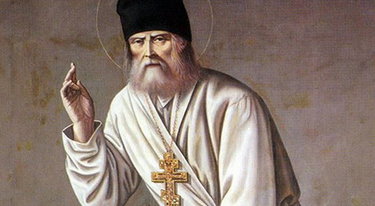
Venerable Mark of Ephesus. Fresco in the Church of Peter and Paul at the Moscow Metochion of the Vvedenskaya Optina Desert, 2004.
Venerable Mark of Ephesus was a courageous defender of Orthodoxy. A remarkable and energetic figure, he stood firm in his devotion to God and never yielded on Orthodox teachings. For six centuries, his example has inspired believers who face their own decisive moments — to follow Christ into His small flock, even when that flock shrinks down to a single sheep: you. Do not fear being alone. Known in Greece as the "Ephesian Warrior," Saint Mark showed in the fifteenth century how one person can stand firm in spiritual struggle, remain true to faith and truth at a critical turning point for the Church, and endure through God's strength without any support. Despite widespread opposition — not only from outsiders but also from his own people — he remained loyal to Orthodoxy. Saint Mark of Ephesus stood alone but never gave in; he safeguarded for us Orthodoxy's purity and beauty. When other bishops challenged him, asking, "What will you do now? You are completely alone!" — he replied calmly: "I am not alone; I am the Orthodox Church."
Today, those who seek truth still find it within Orthodoxy, partly due to Saint Mark's sheer presence and unshaken perseverance. Through his prayers, Lord, strengthen us sinners as well!
You took up the divine writings of the God-inspired theologians, and with a prophetic mind declared the true procession of the Holy Spirit, as it must be. You have sealed forever the Holy Creed, all-praised one. For this we sing to you: Rejoice, Mark, inspired by God.
Kontakion, Tone 8
Prepared by the team of obitel-minsk.ru
Photographs from the internet
Sources:
1. Autocephaly of the Russian Church — Wikipedia
2. The Union in Belarus | Minds.by Archive
3. Miracles of Saint Mark of Ephesus in the 21st Century / pravoslavie.ru
4. Miracles of Saint Mark of Ephesus in the 21st Century / Orthodoxy.ru
5. One Soldier in the Field — Holy Mark of Ephesus, Confessor of Orthodoxy | Borisov Diocese | Borisov Diocese of the Belarusian Orthodox Church | blagobor.by
* A learned Orthodox theologian, church writer, translator, commentator on texts by the Church Fathers, disciple of Saint John of Shanghai, Archimandrite of the Orthodox Church in America, †2004
** The Face-side Chronicle of Ivan the Terrible was likely created between 1568 and 1576 exclusively for the tsar’s library, and exists in a single copy. Its pages come alive with miniatures showing scenes from world history, and from Russian history in particular. Amongst these illustrations, a series of more than twenty pictures tells the story of the Ferrara-Florence Council, the union it produced, and the celebrated deeds of Saint Mark of Ephesus.