Whoever wishes to catch a young bee should take violets in his hand; and whoever desires the presence of the Holy Spirit must keep his heart pure.
St Simeon of Dajbabe
“My beloved, a horse is never held back by its colour, just as a Christian is not held back by their rank. Only when dishonestly gained does it bring harm,” a tall monk in a well-worn habit once told a guest of high standing, with a gentle smile. “Always do what is right, and let no one’s worth be weighed except by their sin. Keep your thoughts on your soul, whether you live in a palace or a cave.” The father embraced his guest, who smiled back, and hurried to the church where people were already gathering, taking refuge from Montenegro’s blazing sun beneath a wooden shelter. That tiny, half-buried chapel holds only a few people. But on Sundays and feast days, not even the shelter can contain all who stream here…
A scene much like this greeted visitors to Dajbabe a century ago. Today, the Dormition Monastery stands on the spot. The relics of its founder, St Simeon, rest in a reliquary within the cave church he carved from living rock.
The faithful know this place far beyond Serbia and Montenegro. Pilgrims come here from across the world, seeking comfort, help, and healing.
In 2012, the Russian Orthodox Church added St Simeon of Dajbabe to its calendar. His life was deeply linked with the Russian Church, and the Orthodox faithful know him well. They flock to Dajbabe particularly on 1 April, the day of the saint’s repose. His final days recall those of Elder Nektary of Optina, who prayed for a peaceful end just before the Godless authorities came to arrest him. It was much the same for St Simeon. Foreseeing the disaster that the Nazis would bring in the twentieth century, he begged the Creator to take him: “I do not wish to meet them.” The saint fell asleep on 1 April 1941. By 6 April, Nazi Germany was already bombing Belgrade.

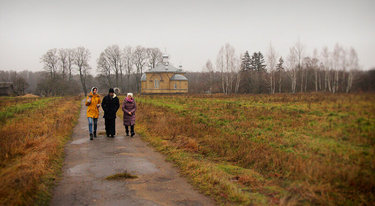
The road to Dajbabe Monastery winds through an orchard
Accounts from Russian travellers tell of their encounters with the venerable Simeon, especially during the years of his greatest effort, when he laboured tirelessly to set up the monastery.
“Two years ago, in 1896,” wrote M. Petrov in 1898 in his essay ‘A New Monastery in Montenegro,’ “Father Simeon set his heart on founding a monastery near Podgorica. He bought a plot on Dajbabe Hill and, with little money in hand, put up a wooden hut, hoping one day to build a stone church and living quarters for the brethren. He planned it all in the expectation of an inheritance soon to come after his wealthy grandfather’s death, for he was the rightful heir. But the inheritance never came. With no way to build in stone above ground, Father Simeon dug a church from the rock itself — using nothing but his hands.”

Father Simeon Popovic and his chapel. Photograph from Reginald Wyon’s “The Land of the Black Mountain. The Adventures of Two Englishmen in Montenegro.” 1903
Prince Dmitry Golitsyn (Muravlin) also wrote of this remarkable man in his book By the Blue Sea:
“Father Simeon is truly an extraordinary character, a real saint — around fifty in years but so youthful in appearance he looks not a day over thirty. In his previous life as a layman, he fought the Turks and even travelled to Paris. Later, he felt a deep calling toward the monastic life. For a long time, he lived in the monasteries of Vranina and Ostrog, putting himself through every sort of hardship. Now he is digging out his own cell in the rock not far from Podgorica. His life’s aim is to build up, stone by stone, a little church beside that cave-cell.”
In Montenegro, churches rise across the land thanks to the energy of people like Father Simeon. They rise not from a worker’s modest gift, but through endless toil — as a harvest from God on fields made fruitful by sincere Orthodox faith. Many more years of effort still await Father Simeon. Yet I trust good souls will come to his aid. Even as I write these lines, a beginning has already been made: over fifty icons and many other items for the church have already been gathered and are soon to be sent by me to Montenegro, both for Father Simeon and the church at Belosani.

Prince Dmitry Petrovich Golitsyn (Muravlin)
Never before have I crossed paths with a more captivating soul than Father Simeon. He radiates a boundless purity and the gospel-sharp simplicity that so endears us all to Father John of Kronstadt. You can see such warmth in his eyes; they shine with a gentle fondness that brings you an immediate sense of peace and joy. Father Simeon keeps to a strictly simple diet and looks on cheerfully while we tuck into lamb. The sun beats down mercilessly, heating the air in shimmering stripes along the road. It pains me to look at Father Simeon — his black klobuk seems to soak in the burning heat, never giving his eyes a hint of shelter. Yet he simply shrugs it off, smiling with good humour and sharing tales from his travels. He has been to Jerusalem, Egypt, and Athos; he knows Europe well and remembers only good things from every place he has seen. Through such men, the world discovers light and kindness.
He was born in Cetinje on 19 December 1854, Saint Nicholas’s Day, to Vaso and Stana Popovic — their only child. They christened him Savva, after St Sava of Serbia. He lost them while still a child; yet, by the deep and mysterious working of God, he found a sound, faithful upbringing at the hands of his grandfather Milan and Milan’s brother, Laza Popovic, the parish priest at Cetinje who had both baptised and anointed the boy as a newborn. Lessons at the monastic school in Cetinje, founded by Bishop Njegoš himself, furthered Savva’s understanding and love for theology. He excelled at his studies, especially in Church Slavonic, singing, and penmanship. What he loved most of all, however, was drawing. The school frowned on it, as paper was expensive and had to be saved. Savva sketched anyhow, even in class. “Savva’s an idler, that is why he doodles,” the teacher would grumble. Because of this pastime he missed out on the honours his classmates received, even though he did well in every subject.

Savva sang beautifully and played the gusli well; yet he was hardly the most obedient of boys and he often tested the patience of his elders. When his friends started smoking, he joined in readily enough. But the moment he discovered it was sinful, he stopped. Well into old age, the saint would look back on his unruly boyhood with a sense of regret.
As a young man, Savva faced his first difficult choice in life. His grandfather Milan pressed him to marry quickly and take charge of the family estate that would one day be his. But the young man’s heart was pulling him in another direction, towards a life of the spirit. Fortunately, his uncle Mikhail stepped in and persuaded Milan to send Savva to Russia, to Kiev, for more schooling.

Savva Popovic, Kiev, 1885
With the blessing and recommendation of Metropolitan Illarion of Montenegro, Savva went to Metropolitan Philaret of Kiev, becoming a scholarship student of the Russian Church. He studied at the Kiev Seminary and Theological Academy, inspired by the lives and struggles of the Lavra’s great founders, the venerable fathers Anthony and Theodosius, and their many spiritual heirs. His spiritual father was Hieroschemamonk Nikolai, who later guided him towards the monastic path. Before Savva’s return to Montenegro, this elder presented him with a collection of books bearing his stamp — volumes still kept in the library of the Dormition St Simeon Monastery at Dajbabe.
After completing his studies at the Academy but before taking his monastic vows and leaving the world behind, Savva felt a need to learn more. He turned his attention to secular philosophy, attending lectures in Paris, at the Sorbonne, and in Geneva.
Guided by his spiritual father’s gentle counsel, Savva Popovic chose the monastic life. He travelled to the Kiev Caves Lavra and, on the feast of the Three Hierarchs, took the habit and received the name Simeon. The saint himself described that day:
“The night drags on. I cannot sleep. My mind runs over the vows I will take in the morning. It is cold. Clear. The full moon lights everything as bright as day. I leave the world behind. The semantron is struck, monks gather. I descend to the cave church and join them. My spiritual father arrives — Hieroschemamonk Nikolai — bearing cassock, riasa, klobuk, cross, prayer rope and candle. Here lies the paraman. Beside the tomb of St Anthony, founder of the cave monastery, the service begins. I hear my name, Savva, offered up in the litany. My spiritual father, taking away my worldly clothes, places his hand on my arm, covers me with the mantle, and leads me to the royal doors. The abbot, Archimandrite Juvenaly, questions me three times and hands back the scissors each time. Then they cut my hair and give me the monastic name Simeon. Some of my friends are in tears.
They place a cross and candle in my hands and leave me standing before the royal doors. I receive Holy Communion. After the rite of tonsure is complete, I am overwhelmed with joy. That was on the feast of the Three Hierarchs — Saint Basil the Great, John Chrysostom, Gregory the Theologian — 12 February by the new calendar. Two days later, on the day of Saint Triphon, I would be ordained deacon in the Brotherhood Monastery. Then, on the Presentation, I became a hieromonk."

Saint Simeon of Dajbabe at the beginning of his monastic path
After ordination, Father Simeon travelled to Moscow and St Petersburg before returning to Montenegro. On the feast of the Annunciation, he arrived in Cetinje to see Metropolitan Mitrofan. The Metropolitan appointed him to the Monastery of St Nicholas at Vranjina. A new church and living quarters were already going up there. Malaria, however, laid him low and, in autumn 1889, he was sent to Ostrog Monastery — the place he had longed for since childhood, to pray before the relics of St Basil of Ostrog.
Around this time, Metropolitan Mitrofan (Ban) opened the first monastic school in Montenegro, in Ostrog; Father Simeon, as one of the best-educated monks, soon became a teacher there. He offered the Divine Liturgy, welcomed streams of pilgrims, spoke of the life of the great wonderworker of Ostrog, and prayed for the sick. During these years, he made pilgrimages to Mount Athos and the Holy Land.

Frescoes by Saint Simeon inside Dajbabe Monastery
Pilgrims recalled their meetings with Father Simeon:
“Evening was drawing in as we reached the lower monastery. The service in the little church had just ended. We arrived weary, grubby and hungry, and the thought of yet another conversation in Serbian before supper or even rest struck us as an ordeal too far. Relief washed over us when we heard, ‘Vous parlez français, mesdemoiselles?’ and we were introduced to a tall man in flowing black robes and the high hat of an Orthodox priest. With his long chestnut hair falling to his shoulders, he was strikingly handsome; more like a magnificent figure from a da Vinci painting than a man of flesh and blood. In a gentle, halting French, made up of short, simple phrases, he softly urged us to sit, assuring us we were most welcome. “For we are Christians,” he said plainly, ‘and is hospitality not among the very first of Christian virtues? You have come so far to see us — this is the least we can do for you.’”
“From England,” he repeated. “You came alone, all the way from England, just to see Montenegro — what a journey! True heroes, you are!”

Saint Simeon of Dajbabe in 1918
Around this time, a shepherd named Petko Ivezic from the village of Dajbabe received a vision that would set Father Simeon’s life on an entirely new footing. Father Simeon wrote of it himself: “I will set down here how the monastery came to be, and let each person make up their mind as they will.” Then he continues: “One day at Ostrog Monastery, I was visited by a shepherd named Petko from Dajbabe, a village near Podgorica. He shared a vision, which came to him in 1890 — not in a dream, but with his eyes wide open: ‘I was tending cattle on a hill among graves, eating bread and cracking nuts, when suddenly I caught the scent of incense. Looking up, I saw a man dressed all in gold, sitting atop a great stone slab. Upon his head, a hat, its crown flaring out, with a cross at its peak. Nearby, a staff topped with golden apples and a yellow cloth; close at hand, two children.
‘He spoke: “I am a saint, hidden here from the Turks.* Once, I was lord of this place, son of a saint who lived before Kosovo” (that is, before the great Battle of Kosovo in 1389). “I wish you to build a monastery for me here.” I said, “But I am poor, father.” “I do not look for the rich. If you wished, you would find a way. Start with a little chapel…”’
That shepherd — an orphan now, looking after other people’s cattle — later described seeing not just any man, but a bishop in full vestments; the two children, he realised, were Angels. Mulling over those words, he became convinced a holy place once stood here, especially after recalling the ancient rulers and bishops of Zeta. He took it as a sign, a calling from God: each soul has its path to salvation. And so he decided to give all he had — resources, labour, heart — to this spot. To begin, he petitioned King Nikola, now departed, and Metropolitan Mitrofan for their approval.”
This is how the church of the Dormition looked in its earliest days, when Dajbabe Monastery was first founded
Later, Petko Ivezic became a disciple of Elder Simeon, took the monastic habit and received the name Platon. He served as a hieromonk, spending his final days as a ninety-year-old elder at Dajbabe Monastery.
Once the church was built and ready, Father Simeon sought the metropolitan’s blessing for its consecration. The service was held on the feast of Saint Anastasia the Roman, 22 December 1897. He dedicated the church to the Feast of the Dormition of the Mother of God. Metropolitan Mitrofan (Ban) was the first to lend a hand, providing all the icons and vestments needed for daily worship.
Only God and the Holy Mother of Christ could ever truly know the trials that Venerable Simeon of Dajbabe endured: each tear shed, every drop of sweat, all his fasting, his prayers both public and private, his quiet hours of contemplation. These spiritual disciplines filled his solitary days and nights. Through them he climbed to greatness amongst his fellow men, winning honour and renown as a holy man of God, blessed by the Almighty and revered by the people.

Venerable Simeon of Dajbabe in his later Years. On the right — Professor Dr Niko Simov Martinovic, 1931
Answering the call of his age, Saint Simeon often reached for his pen. He wrote helpful, easily read books for the people — often in verse — offering guidance and advice on following the spiritual path. In these works, he showed how Christians might overcome every hurdle that blocks their way as they strive to grasp and live out humanity’s eternal calling: to become like God and belong to the God-Man’s Heavenly Kingdom.

Roses at Dajbabe Monastery
Saint Simeon painted the cave church himself. His frescoes appear throughout other parts of the monastery too. They strike the onlooker by the purity and clarity with which the saint reveals the spiritual reality of the heavenly world.
Later years brought frailty, and his disciple, Igumen Theophil (Popovic), who succeeded him as abbot, cared for him. Yet even then, he let nothing — no matter how weak his body — break his strict rule of prayer in solitude. He reposed on the Tuesday of the fifth week of Great Lent, the day the Church remembers the martyrs Chrysanthus and Daria, having just received the Holy Gifts. Quietly, the great ascetic gave his soul into the Lord’s hands and was laid to rest, according to his wishes, inside his own little church — in a tomb hewn into the wall.
In the spring of 1996, on 5 March, Metropolitan Amfilohije of Montenegro and the Coast discovered Saint Simeon’s relics and placed them in a reliquary within the Dormition church. On 29 April 2010, the Holy Synod of Bishops of the Serbian Orthodox Church glorified Simeon (Popovic) as a saint, now venerated in both the Serbian and Russian Orthodox churches.

Reliquary with the relics of Saint Simeon in the Dormition Church at Dajbabe Monastery
Venerable Simeon often spoke of the Jesus Prayer, which he himself practised so diligently. “At first, this prayer,” he would say, “simple as it is, does not come easily; you must work at it, even using outward effort: recite it aloud until it becomes part of you, repeat it under your breath whatever task your hands must do... and in time, it will come naturally, almost on its own.” May we, by the prayers of this great ascetic, also receive such grace, God willing.
Guide of Orthodoxy, Teacher of Piety and Purity, Light of the Universe, God-Inspired Adornment of Monks, Wise Simeon — Through Your Teaching Enlightened Us, Flute of the Spirit, Pray Christ Our God to Save Our Souls.
Troparion to Saint Simeon of Dajbabe, Tone 8

Dajbabe Monastery
Prepared by the team of obitel-minsk.ru
Photographs from the internet
Sources:
1. A Pure Heart Sees God: The Life and Works of Elder Simeon, Wonderworker of Dajbabe. Montenegro, Dajbabe Monastery, 2016
2. Tales from Montenegro: Dajbabe Monastery through the Eyes of Pilgrims
3. Dajbabe Monastery, Podgorica / photo album by kvesisskaya at Turister.ru
4. Simeon (Popovic) of Dajbabe: Life, Icons, Feast Day / azbyka.ru
* Possibly, due to Turkish occupation, Bishop Hilarion (Shishovic), originally buried at Vranjina Monastery (in the 1230s–1240s), was reburied at Dajbabe.