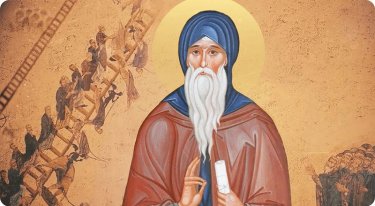
The Lord loves people but sends trials so that they may learn their weakness, humble themselves, and by their humility receive the Holy Spirit; and with the Holy Spirit all is well, all is joyful, all is beautiful. Whoever humbles himself will be content with any lot because the Lord is his wealth and joy, and all will marvel at the beauty shining from such a soul.
Venerable Silouan of Athos
“Father, I will not go anywhere! I will lie down under a boat or beneath a rock and die here on Athos!”
“No, child,” the elder answered, “it is God's will that you live in Russia; there, people need saving.”
Father Melchisedek led his thirty-eight-year-old disciple out of the cell and asked:
“Do you wish to see how the elements bow to man?”
“I do, Father.”
“Then look,” — the elder made the sign of the cross over the dark night sky, and it grew bright; he crossed it again, and it curled up like birch bark, and Father Xenophon saw the Lord in all His glory, surrounded by a host of angels and all the saints. What was shown to them, what they saw and heard, the monk never spoke of afterwards. At that moment he covered his face with his hands, fell to the ground, and cried: “Father, I am afraid!”
After a moment, the elder said: “Rise, do not fear."
Father Xenophon rose from the ground — the sky looked ordinary, and the stars still twinkled…
Thus, in 1913, the future Venerable Confessor Kuksha of Odessa was comforted and strengthened for the trials yet to come — back then, he was the mantled monk Xenophon of the Panteleimon Monastery.

The skull of Hieroschemamonk Melchisedek (Dmitrienko), kept in the ossuary of the Panteleimon Monastery
Saint Silouan had not yet grown to full measure to speak to the world and say: "O all people, let us humble ourselves before the Lord and for the Kingdom of Heaven! Let us humble ourselves, and the Lord will grant us to know the power of the Jesus Prayer. Let us humble ourselves, and the Holy Spirit Himself will teach the soul. O human, learn Christ’s humility, and the Lord will grant you to taste the sweetness of prayer." Yet early twentieth-century Russian theologians also lacked the heartfelt prayer and spiritual insight needed to understand what the Athonite monks meant when they tried to put into earthly words a spiritual truth beyond human knowing. And in 1912–1913, an attempt to set out the theological grounds for Orthodox reverence of the sacred Name of God led to turmoil on Mount Athos. Fearing disorder, the Greek authorities demanded that many Russian monks leave Athos, including the future saint.
On Athos, the Venerable Kuksha laboured from a young age. Born into a devout peasant family in the Kherson province, he returned from pilgrimages to the Holy Land and the Holy Mountain with a burning wish for the monastic way. His mother, Kharitina, welcomed her son’s calling with joy, while his father, Kirill Velichko — a stern yet God-fearing man — needed a full year of persuading before he agreed to let his middle son Kosma go to Athos.

The Russian St Panteleimon Monastery on Athos, 1870s
A year after Kosma reached Athos from Jerusalem, the Lord granted him another stay in the Holy City. This time he went for a year and a half, taking his turn serving at the Lord’s Tomb. After his return to Athos, Kosma received the duty of guest-keeper at the pilgrims’ hostel, where he laboured for eleven years. By carrying out this duty with diligence, he grew in gracious patience and true humility. Before long, the novice Kosma received the tonsure into the rassophore with the name Konstantin; then, on 23 March 1904, he made his full profession as a monk and received the name Xenophon.
Xenophon’s spiritual father was the ascetic, spirit-bearing Elder Father Melchisedek, who lived as a hermit in the mountains. With him, Xenophon learned the first rules of monastic life, trained for the inner struggle against the spirits of wickedness, and gained a sound view of the ascetic path. Later, the venerable one remembered those days: "I served in obedience until midnight, and in the first hour of the night I ran to the wilderness to Elder Melchisedek to learn how to pray."

The twentieth century brought great upheavals: social unrest, crises, world wars, revolutions, and persecution of the faithful. This was the thorny path by which, after seventeen years in the domain of the Mother of God, the Lord led the Venerable Kuksha to his holiness.
When the First World War began, Father Xenophon and other monks were sent to serve as Brothers of Mercy on a hospital train that ran between Kiev and Lvov. There, he cared for the gravely wounded, carried them on his own back, and often had to endure insults from men broken and soured by the war. But Monk Xenophon bore their burdens as if they were his own (cf. Galatians 6:2).
After finishing his service on the medical train, the saint settled in the Kiev-Caves Lavra. Soon he was ordained a hierodeacon and then a hieromonk. In this ancient monastery, he carried out obedience in the Far Caves: he trimmed and lit the lamps before the holy relics, changed the vestments of the saints’ relics, and kept the place clean and in good order.

The Venerable Confessor Kuksha at the Kiev Sloboda Church of the Resurrection of Christ shortly before his arrest and imprisonment
Once, while reclothing the relics in the Distant Caves, the Venerable one prayed at the shrine of the schema-monk Silouan, asking to be admitted to the schema. At fifty-six, Father Xenophon fell so gravely ill that no one expected him to live. Believing he was dying, they tonsured him into the great schema and named him after the Holy Martyr Kuksha of the Caves. Soon after, Father Kuksha began to get better, and in time, he made a full recovery.
Yet Schema-monk Kuksha, a servant of God, did not live out his schema in the quiet of a cell but at a logging camp in the Solikamsk district. In 1938, at the height of Stalin's purges, the venerable one was exiled there for eight years. At sixty-three, he worked fourteen-hour days in the biting frost, with very little food to eat.
Once, Bishop Anthony (Abashidze) of Kyiv sent a hundred particles of the Holy Gifts into the camp for Venerable Kuksha, so that the father might partake of them. But Father Kuksha chose to share the Holy Gifts with all the priests, monks, nuns, and anyone else who wanted them. On the set day, the imprisoned priests — wearing epitrachelions made from towels, with crosses drawn in ink — walked out to work. Out of sight of the guards, hidden by the scrub, they quickly heard confessions, gave absolution, and communed the people with the Holy Mysteries. That morning, a hundred people in the camp received Holy Communion. For many, it was their last. Of those years, the elder later said, "Perm is the second Jerusalem."

Sites of exile of the Venerable Kuksha of Odessa — Perm Region, Verkhnekamsk
After the camp, Father Kuksha spent another three years of exile in the Kungur district. Only in 1948 did he manage to return to the Kiev-Caves Lavra. Even in exile, long lines formed of those wishing to speak with the Venerable one — people came simply to talk to him, to confess. After his return to the monastery, visitors began to arrive from across the country. He lived and worked in the spirit and strength of venerable fathers such as Seraphim of Sarov and the Optina and Glinsk Elders, and, like them, received the gifts of discernment and the healing of soul and body. Many who came for counsel or comfort he met with the answer or word they needed before they could ask. The Venerable one gave counsel, knowing God's will for each person, and so helped them at turning points in their lives.
This remarkable saint's life took him through several countries and monasteries. He bore sorrows and persecution from godless authorities, who moved the elder from one monastery to another, hoping Father Kuksha would be forgotten, lost from sight, and left alone. Yet, a steady stream of spiritual children, worshippers, and pilgrims seeking Christ’s comfort through this grace-filled elder never failed to follow him, sweeping over the places where he laboured: Pochaev, the Kreshchatitsky Holy John the Theologian Monastery of the Chernovtsi Diocese, the monastery in Odessa, and others.

Schema-Archimandrite Kuksha (right) and Archbishop Eumenius (Khorolsky), who sheltered the elder after his expulsion from Pochaev Lavra, at the Kreshchatitsky John the Theologian Monastery, 1960s
As Elder Kuksha’s life neared its close, he yearned to return to his home monastery of Saint Panteleimon. His final earthly home became the Odessa Dormition Monastery, where he was sent in the ummer of 1960 when the Kreshchatitsky Monastery closed. At that time, Hieromonk Jeremiah (Alekhin) served as cellarer in the Odessa community. At fourteen, he had been sent into exile with his parents to the upper reaches of the Kama, in Perm Region.
God’s providence is beyond our knowing, yet it seems clear that the Way of the Cross drew these ascetics together. When illness began to overcome him, Schema-Archimandrite Kuksha asked Father Jeremiah to bring him Holy Communion. The devotion with which Father Jeremiah served the Venerable one until his repose — giving him the Holy Mysteries of Christ each day — drew a great outpouring of Divine grace. One day, the saint, half in jest, said to him, "How can I reward you, my child? You shall become an abbot on Athos."
The Venerable Kuksha blessed Father Jeremiah to seek permission to go to Mount Athos, to the Russian Holy Panteleimon Monastery there. In 1974, Patriarch Demetrius of Constantinople chose three of the six monks who applied from the USSR, and Father Jeremiah was among them; on 5 June 1979, he was confirmed as abbot of the Russian monastery. He received the monastery with fourteen brethren rather than the two thousand it once held in the days of the Venerable Kuksha. Over more than forty years of service, he gathered a new brotherhood, restored monastic life, repaired the run-down churches, and took on many other tasks at the Holy Panteleimon Monastery. Keeping his spirit strong and his body sound, he reposed at the age of one hundred and one.

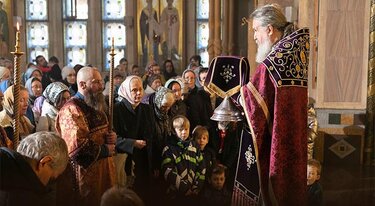
All-night vigil on the feast day of the Venerable Confessor Kuksha at the Odessa Dormition men’s monastery
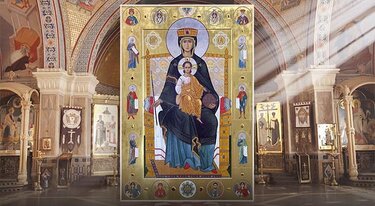
By this time, Schema-Archimandrite Kuksha had already been glorified among the venerable confessors. Today, his relics rest in the new cathedral of the Odessa Stavropegial Dormition Monastery, dedicated to the icon of the Mother of God "Life-Giving Spring." The lower church has been consecrated in honour of God's saint. On the days of the saint’s remembrance — 24 December, the day of his repose, and 29 September, the day the relics were found — thousands of the faithful come here. Many receive God’s help and spiritual comfort through the prayers of the Venerable Confessor Kuksha.

Report of Metropolitan Agafangel of Odessa and Ismail on the inclusion of Schema-Archimandrite Kuksha (Velichko) among the venerable
Through the prayers of the new martyrs and confessors of the Russian Church, who passed through the trials of the twentieth century, the Lord showed mercy to our homeland. He turned wrath into compassion. Church life began to revive, including on Athos, where today more than a hundred of our countrymen labour in asceticism. May the prayers of God's servant, the venerable Confessor Kuksha, help us too to obtain forgiveness and mercy from the Lord!
Today, we joyfully praise the Venerable Kuksha: an angel on earth and a man of heaven, a firm confessor and Spirit-bearing elder, a teacher of repentance and a preacher of purity. Rejoice, blessed Kuksha; rejoice, you who guided many onto the path of salvation; rejoice, praise of the faithful and strength of the Russian land; pray for our souls.
Sticheron, Tone 6
Prepared by the editorial team of the website obitel-minsk.ru
Photographs from the internet
Sources used:
1. The settlement of Vilva as one of the sites of mass deportation of the Cossacks of the Poltavskaya stanitsa in 1932 | Golos Pravdy — News of the Krasnoarmeysky district
2. Material and living conditions of special settlers in the Perm region in the 1930s
3. New Martyrs and Confessors of the Twentieth Century. Venerable Kuksha of Odessa
4. Spiritual Father and Confessor: Orthodox Canada
5. Venerable Kuksha (Velichko), Schemigumen (1875–1964), not in the caves, commemoration 24 December (N.S.) — Holy Dormition Kyiv-Pechersk Lavra
6. Life of the Venerable Schemigumen Kuksha (Velichko) — Holy Dormition Kyiv-Pechersk Lavra
7. "О elder, a place in these caves has long been prepared for you!" — Holy Dormition Kyiv-Pechersk Lavra
8. Stanislav Chabutkin — Athos: vsefoto — LiveJournal
9. Venerable Silouan the Athonite / Schema‑Archimandrite Sophrony (Sakharov). 3rd ed. — Sergiev Posad: Holy Trinity St Sergius Lavra, 2011
10. Archimandrite Sophrony (Sakharov). On Prayer. — Holy Trinity St Sergius Lavra, 2020
11. Schema‑Archimandrite Ieremias (Alekhin): an ascetic of our time