Anyone with a passing interest in the history of the Russian Church knows the story: the discovery of the “Reigning” icon of the Mother of God happened to fall on the very day the Russian monarchy was overthrown. For Orthodox believers, this was a sign: with the Tsar gone, heavenly rule over Russia had passed to the Mother of God Herself. If we know anything, it is that such moments are never a matter of chance. All the more reason, then, to look at the story once again and ask what lies beneath the surface.
Let us begin with a question: why was the sign about the icon’s whereabouts given to a peasant woman? And why a woman seemingly from obscurity? Could the reason lie in what followed? That very ‘worker-peasant power’, launching its assault on the countryside in 1918, aimed to wipe out the peasantry root and branch. These were the people who formed eighty per cent of the Empire’s population. First came the grain seizures, then the brutal ‘kulak purges’, and finally the slavery of the collective farms.

And yet, the discovery of an icon so despised by the Soviet authorities fell to a countrywoman named Evdokia Andrianova. She came from the very heart of nowhere — a hamlet called Pochinok in Zhiroshkino parish, Bronnytsky district. I could find nothing more about her, yet the name Evdokia Andrianova does crop up in the lists of Russia's new martyrs. Specifically, it belongs to a Sister Evdokia, executed in 1942. Could this be a clue, a quiet pointer to what became of this peasant woman?
The timing of her two dreams is also striking, as is the meaning of her name. In Greek, Evdokia means ‘favour’ or ‘goodwill’.
In her first dream, she heard a voice: “There is a great black icon in the village of Kolomenskoe. You must fetch it, turn it red, and let people pray before it.” This dream came to her on 13 February 1917 — the first day of Great Lent, which that year followed right after the feast of the Iveron Mother of God. More remarkably still, 13 February was meant to be the last day of the Russian Empire, if a certain Alexander Guchkov — no friend of Nicholas II, and a leader of the liberal opposition — had his way. He had planned an armed uprising for 14 February, but something, as it turned out, scuppered his intentions.

One more thing draws the eye: what the peasant woman heard in her dream echoes strangely in a letter the Empress wrote to the Sovereign on 3 March 1917 — the day after the abdication and the icon's discovery. She writes of another icon of the Mother of God — the “Sign” of Tsarskoye Selo: "We had a wonderful moleben and akathist before the icon of the Mother of God... I placed Them [the Children] and you under Her holy care. Afterwards, the icon was carried through each room… Everything around us is as black as night, and yet God rules over all. We do not know His ways or how He will help, but He hears every prayer.”
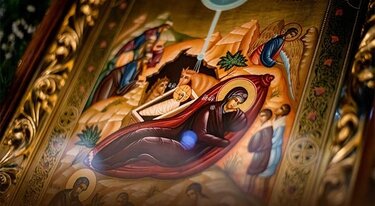
“A black icon… all around as dark as night, yet God rules over all…” — that is precisely what the icon shows us. The night that fell over Russia is painted deep and shadowy, but against it stands the figure of the Mother of God, Her robe a bright red, the Christ Child on Her lap, and in Her hands the sceptre and orb of kingship.

But why did Evdokia wait? What stopped her from setting off for Kolomenskoe straight away? Why did she only go two or three days later, after a second dream, which she saw ten days after the first, on the night of the twenty-sixth?
Only one thing is clear: both dreams — one coinciding with a failed coup, the other with one that upended the country — and the unearthing of the “Reigning” icon on the very day that the Russian monarchy met its grisly, sordid end — these are hints left for those willing to see, if they know how to read such things. Did Evdokia know of the bloody orgy in the capital, amidst the so-called “bloodless Great Russian Revolution” celebrated by Kerensky? General Konstantin Globachev, the last head of the Secret Police, left some stark lines in his memoirs: “No words can capture the savagery unleashed by the mob during those February days — what the police, the gendarmes, even the officers endured. It was every bit as cruel as what the Bolsheviks would later do to their victims. Policemen hiding in cellars and under rooftops were literally torn limb from limb. Some were crucified against walls. Some hacked to pieces with swords or torn apart by being tied by the legs to two cars. There are accounts too of the arrested police officers being shot by the river, their bodies flung beneath the ice. Those in uniform who did not manage to change into civilian clothes and hide were butchered without mercy. For example, one was tied with ropes to a couch and burned alive along with it.”
Other witnesses left similar accounts. And in the middle of that gruesome frenzy, how many people could see God at all? The violence erupted with the mutiny of the Pavlovsky regiment, on the very day Evdokia dreamed of “a white church, and within it, a majestic Woman, Her face hidden from view.” That same day, the Commander-in-Chief — betrayed within twenty-four hours by everyone, from the president of the Duma to the staff, to his commanders, the Synod and his own royal kin — suffered a strange heart attack at the Divine Liturgy, as he stood before an icon of the Mother of God.

“My old heart made itself felt,” he wrote to the Empress from his headquarters in Mogilev, “This morning during the service I felt an agonising pain in the centre of my chest. It lasted for a quarter of an hour. I could scarcely stand through the service; sweat beaded my forehead. I cannot make sense of it — my heart did not seem to beat at all; but then the pain struck, and just as suddenly, it left the moment I knelt before the icon of the Most Pure Virgin.”
That icon — the Vladimir Mother of God — had been brought to Mogilev at Alexandra Feodorovna’s insistence. Before it, in lashing rain, prayers were offered for the success of the Russian offensive — the one we call Lutsk, or Brusilov breakthrough. The second push, planned for the spring of 1917, should have concluded with Russian troops marching through Berlin. Neither Russia’s “allies” nor their sponsored “fighters against autocracy” back home would allow that. Instead, the country crumbled through the combined efforts of reservists gone rogue, convicts freed from jail, so-called “people’s representatives,” and generals — Alexeyev foremost among them — who simply ignored the Tsar’s command to send loyal troops to mutinous Petrograd.

On the 26th, one regiment turned against its commanders. The next day, flames roared through the District Criminal Court on Shpalernaya, and the red banner flew above the Winter Palace. In those fateful days, as Vasily Rozanov wrote, “everything fell apart at once — kingdom and Church.” Fell apart, yes, but it did not completely break — and will not. The appearance of the Reigning Icon seemed to promise just that: it showed up on the very evening when, according to common belief, the Tsar-Martyr renounced the throne and passed it to his brother Mikhail Alexandrovich. And here, once more, we stumble upon some remarkable ‘coincidences’.
The white church Evdokia saw in her dream stood in Kolomenskoe and was dedicated to the Ascension of the Lord. So too was the church opposite the Ipatiev House in Ekaterinburg — the notorious “house of special purpose.” Also named for the Ascension was the monastery from which, in the year of Napoleon’s invasion, a third-belt (prophetic tier) icon of the Mother of God, painted in the Byzantine style at the end of the eighteenth century, was brought to Kolomenskoe. But when the rector, Father Nikolai Likhachev, heard Evdokia’s story, they could not find it among the icons on display. It was only when they went down into the cellar that they found it — the very one from her dream.

The First Great War — and the second, nearly won, then snatched from Russia by those whom Dante, for their treachery, damns to the ninth circle of hell. One basement, and then another — the infamous execution room.
And that same icon, soon revered across all of Orthodox Russia, sometimes called Kolomenskaya, sometimes Reigning, and sometimes the Great Reigning Icon. But now, its story had moved to Ganina Yama.
In 1921, the investigator Nikolai Sokolov recorded the words of N. N. Shabelsky-Bork:
“At 4 o’clock in the morning on 17 July [1918], everything fell silent. The peasants hurried straight to Ganina Yama and there they found several personal effects. They started to pump water from the mine shaft, calling in students and officers alike. Among the items unearthed, I remember the Great Reigning icon of the Mother of God — stabbed through with bayonets. Grand Duchess Elizabeth Feodorovna had sent it to the Tsar via Countess Tolstaya.”
That icon: torn by steel, the “Queen of Heaven” of the Russian land… Those Grand Duchesses, cut down by bayonets… Their innocence brings to mind the lilies that now grow at Ganina Yama, and at another dark pit, the mine near Alapaevsk. And then there was the prayer, found among papers in that ‘Special Purpose House’. Its words had apparently been written in November or December 1917, days after the October upheaval. Elizabeth Feodorovna had sent it along with the icon to the royal family, and her sister had copied it out by hand:
“O Sovereign Lady, Most Holy Mother of God, who cradles in Her arms Him who holds the whole world in the palm of His hand, the King of Heaven! We thank You for Your unspeakable mercy. You have seen fit to reveal to us, sinners, Your holy icon in these troubled and harsh days, wild and stormy as they are — days of shame and disgrace, days when fools defile and ruin our holy things, not only in their hearts, but with their lips and tongues, daring to say, ‘There is no God!’ and show their unbelief in all they do. We thank You, for from Your high throne You have looked upon the sorrow and grief of Your Orthodox children, and like the rising sun, You comfort our weary, grieving eyes with the sweet sight of Your Sovereign image!
O most blessed Mother of God, Sovereign Helper, our mighty Defender, in awe and trembling, we offer You our thanks and fall down in humility, tears, and the breaking of our hearts, crying out and pleading, ‘Save us! Save us! Help us, for we perish.’ Hell itself draws near. Countless sins, troubles, and enemies beset us on every side.
O Queen of Heaven, scatter our enemies — seen and unseen — who wage war on us and mock our Orthodox Church, who destroy our homeland. Scatter their proud schemes, bring them to nothing! Take Your sceptre and sweep them away like dust, like smoke. Plant truth, peace, and joy of the Holy Spirit deep within every heart; bring to our land quiet days, good order, calm, and true love among us all. By Your mighty rule, hold back the floods of lawlessness and evil that threaten to drown Russia in their depths.
Lift us up, O Purest One — give us courage and strength in our weakness and despair. May we, protected always beneath Your rule, sing Your praise and glorify You, Sovereign Defender of all Christians, for ever and ever. Amen.”

Who wrote this prayer — no one now knows. Yet we know of Patriarch Tikhon’s direct role in raising up this icon, and his command to create the “Akathist of akathists” — drawing together a piece from every akathist ever written for icons of the Mother of God. We also know something else: this holy confessor, who cursed the Bolsheviks yet refused to bless the White movement's leaders, did something remarkable at the close of 1918. Through Bishop Nestor of Kamchatka, he sent a prosphora and a small icon of the “Queen of Heaven of the Russian Land” to General Fyodor Keller, just as the general was about to take command of the Northern Army. Was this not a blessing for battle against Trotsky’s troops, given to the one general who, back in March 1917, refused to suggest that the Sovereign give up his throne? In his telegram to headquarters, Keller alone declared himself ready to defend the throne and Orthodox Russia.
Had there been just a few more like him, how different our country’s history might have been!
But the Emperor descends the throne,
Forgiving all, from all released,
The Russian crown now fades alone
In February's mud deceased.
Georgy Ivanov
“Treachery, cowardice and deceit are everywhere.” So wrote the Commander-in-Chief as he left Pskov, betrayed by almost everyone. He spoke of that all-consuming filth — that general baseness — with precious few exceptions. Yet the Russian crown did not fade. Instead, it passed to the Protectress of Christ’s people, as many in the Russian emigration have said time and again.
“The Most Pure Mother of God has not withdrawn Her protective veil from the Russian land. The miraculous appearance on 2 March 1917 of our last wonder-working icon — the Mother of God Derzhavnaya — on the very day His Majesty Emperor Nicholas Alexandrovich abdicated, shows this,” wrote Bishop Averky (Taushev). “What does this tell us, except that the Most Pure Mother of God Herself has assumed the supreme, royal authority over Russia after Her people — mad with frenzy — rejected their sovereign, the Anointed of God? She looks with sorrow upon the people’s harsh suffering, born of their own wild rebellion, and, like a true Mother, waits patiently for their repentance and return to God…”

By Konstantin Kravtsov