9 July - feast of the Tikhvin Icon of the Mother of God (1383)
"Rejoice today, O Christ-loving land of Russia, for the glory of the Lord has shone upon you in the most glorious appearance of the icon of the Mother of God. Wondrously and radiantly it came to you through the air, by the providence of God who orders all things. Rejoice now and be glad, O Great Novgorod, for within your borders you have received the divine dawn shining from above and pouring out the grace of miracles. Be adorned and keep festival in splendour, O most honoured abode of the Mother of God, for your beauty has been made truly fair. Within you is a great treasure for the whole world, for you hold the wondrous icon of the Lady, gloriously come through the air and granting great mercy to all the faithful."
Sticheron, Tone 5
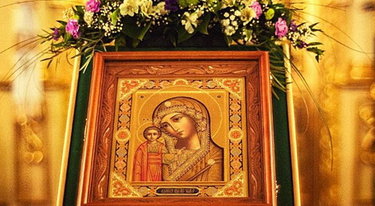
The Tikhvin Icon shines like a star on the northern frontier of the Russian land, preserved by the grace of God. If the Vladimir Icon shines in the centre, the Kazan Icon in the east, the Iveron Icon in the south, and the Pochaev Icon in the west, then in the north there shines the "Queen of the North" - the Tikhvin Icon of the Mother of God - strengthening the faithful in steadfastness, truth, love, godliness, righteousness, and mercy.
"In the year 6891, in the region of Great Novgorod called Tikhvin, there appeared the icon of the Most Pure Mother of God and Ever-Virgin Mary, with the Eternal Child upon Her arm" - so the chronicler records the event commemorated by the Church on 9 July: the coming of the Queen of Heaven to the then deserted Tikhvin land in 1383. "Passing in radiant light through the air" from one village to another, and "borne invisibly by angels", as The Tale of the Tikhvin Icon of the Mother of God says, the icon appeared to local people in several places across the Novgorod land before reaching the bank of the River Tikhvinka. The first in Rus' to see it were fishermen near Lake Ladoga. At the place of its final appearance, a wooden church dedicated to the Dormition of the Mother of God was built that same year, and it became the resting place of the holy icon.
A chronicle also tells what happened next: "Many wealthy merchants of Novgorod, being in Constantinople on business at the time when most glorious miracles were being wrought in Tikhvin by the icon of the Mother of God, spoke of them with the Patriarch there. After hearing all the details of its appearance and miracles, the Patriarch told them that this same icon of the Mother of God had disappeared from Constantinople. He explained that, by divine ordering, it had previously gone out to sea but had returned again to the city, pouring forth miracles upon the faithful, granting victory over enemies, and easing illnesses and sorrows. Finally, it departed irretrievably - surely because of the people's pride, hatred for one another, and injustices. After long conversations, comparing its appearances, miracles, size, form, and other features, they confirmed that the icon manifested in Tikhvin was none other than the one that had been in Constantinople."
According to tradition, the Tikhvin Icon of the Mother of God is one of the icons painted by the holy Apostle and Evangelist Luke. Until the fifth century it remained in Jerusalem. It was then taken to Constantinople, where the Church of Blachernae was built to house it. In 1383, seventy years before the fall of Constantinople to the Turks, the icon disappeared from that church and was found in the northern Russian lands.

Dormition Cathedral of the Tikhvin Monastery - home of the wonderworking Tikhvin Icon of the Mother of God
The Tikhvin Icon became renowned for many miracles and healings. Through this icon, the Queen of Heaven, Who so loved Orthodox Rus', upholds the true faith within it. Again and again throughout history, the Mother of God has protected Russian cities during foreign invasions and strengthened those defending their borders.
The Tikhvin Dormition Monastery left a clear mark on history through our ancestors’ heroic defence of their homeland during a siege. As the Swedish army approached, the monks resolved to flee the monastery and take the wonderworking icon with them. Yet they could not move it from its place. This miracle strengthened the fearful, and they remained, trusting in the protection of the Mother of God. Though few in number, the defenders beat back attack after attack from an enemy far stronger than themselves. At one moment the advancing Swedes seemed to see a great Russian force marching from Moscow, and at another a Host from Heaven - and they fled.
The peace treaty between Russia and Sweden was signed several dozen kilometres from the monastery, at a place called Stolbovo, and became known as the Peace of Stolbovo. After the victory over the Swedes, the tsar's envoys came to the monastery and took with them a copy of the wonderworking icon to Stolbovo, where the treaty was concluded on 10 February 1617. This copy served as the chief pledge of peace on the Russian side. It was later transferred to Moscow and placed in the Dormition Cathedral, and then, at the request of the Novgorodians who had fought in the war, sent to Novgorod and placed in Saint Sophia Cathedral.

The Tikhvin Icon of the Mother of God without its riza
The fourteenth and fifteenth centuries were a turning point, when the centre of Orthodox culture and God-blessed sovereign power began to move to the Russian lands. A local theology took shape, and in Orthodox thought the native land came to be seen as a chosen inheritance of God, entrusted with the preservation of Orthodoxy. The movement of holy icons from place to place was understood in this light: "When God created the sun, He did not set it to shine in one place only. Rather, as it goes on its course, it gives light to the whole world. So too the icons of our Holy Lady, the Mother of God and Ever-Virgin Mary, pass through all lands and give light to the whole world."
This thought of a medieval theologian found unexpected confirmation in the twentieth century, when for fifty-six years the wonderworking Tikhvin Icon shed its light on North America. For many centuries the image of the Mother of God had remained in the Dormition church of the Tikhvin Monastery. But after the persecutors of the Church came to power in 1917, the monastery was closed and devastated in the mid-1920s, and the Tikhvin Icon became part of the local museum collection.

During the Second World War, Tikhvin was seized by Hitler's forces. For almost two months the town remained under occupation. As they retreated, the Germans carried off valuables from Tikhvin, including the wonderworking icon, and took them to Pskov, which they then held. From there the image went to Riga, where it remained for half a year, and then to the American occupation zone in Germany.

Bishop John of Riga (Garklavs) in procession with the Tikhvin Icon of the Mother of God
Archbishop John of Riga (Garklavs) and his adopted son Sergei Kozhevnikov travelled with the Tikhvin Icon through the displaced persons camps in that zone and served before the wonderworking image. Believers invited Bishop John and the icon to their camps, where they put up churches and chapels from planks and sheets of iron. These were very humble places - paper icons, oil lamps made from tins - yet, as Father Sergius Kozhevnikov-Garklavs later recalled after becoming a priest: "How people drew together there, what a spirit there was. In one of the camps a woman asked the Mother of God to help her find her son. Then, after stepping away from the icon, she suddenly saw him among the worshippers - her son had also come to that service in the camp."
In 1949 Archbishop John took the Tikhvin Icon to the United States. It was placed in Holy Trinity Cathedral in Chicago, where Bishop John first served as rector and guardian of the icon. After his retirement, the holy image remained at his residence. Later it was kept in Argo, a suburb of Chicago, in the home of Archpriest Sergius (Garklavs), who devoted his whole life to its safekeeping. Before retiring, Bishop John drew up a will stating that Father Sergius was to return the icon to the Tikhvin Dormition Monastery once it had been restored and once Bolshevik rule in Russia had come to an end.

Archpriest Sergius* and Matushka Alexandra Garklavs before the Tikhvin Icon, Chicago, 2004
"In 2004 we decided to return the icon to Russia," Father Sergius recalled. "His Holiness Patriarch Alexy II of Moscow and All Rus' proposed taking it to Tikhvin through Moscow and Saint Petersburg. But Metropolitan Alexander of Riga and All Latvia wished the icon to return by the same road by which it had left the country - through Riga. So that is what we did. We arrived in Riga on 21 June 2004 and stayed there for two and a half days. The welcome was beyond words. As we entered the city, the bells began to ring, and the streets on both sides were filled with people. Two hundred and fifty thousand people came to meet the holy icon.
"Then the icon came to Moscow, where about half a million people came to venerate it, and after that to Saint Petersburg. On the morning of 8 July, we set off from Ladozhsky Station on a special train to Tikhvin. There, from Cathedral Square to the monastery, the icon was borne along a road strewn with fresh flowers. Thousands upon thousands of the faithful greeted their holy icon, which had left the Tikhvin Monastery in the distant year of 1941 and gone into exile..."
The return of the holy icon was timed to coincide with the feast of its appearance in Tikhvin, and on 9 July 2004 the wonderworking image was welcomed back to its restored home.

Return of the Tikhvin Icon, 2004
One of the oldest and most revered copies of the wonderworking prototype is now in the local tier of the iconostasis of the Annunciation Cathedral in the Moscow Kremlin. Moscow also had other revered copies of the Tikhvin Icon - in the Panteleimon Chapel by the Vladimir Gates of Kitai-Gorod, in the Smolensk Cathedral of the Novodevichy Convent, and in the Church of Saint Nicholas on Shchepy. There were nearly a dozen churches in the capital dedicated to the Tikhvin Icon, and several remain active today. Among them is the church in the former village of Alekseyevskoye. It was never closed and, according to tradition, in the autumn of 1941 the copy of the wonderworking icon once brought there by Tsar Alexei Mikhailovich was carried by air around besieged Moscow. Also open are the churches in Sushchyovo and at the Central Clinical Hospital of the Moscow Patriarchate, as well as the refectory church of the Simonov Monastery and the gate church of the Donskoy Monastery. In Saint Petersburg, on the banks of the Neva, there were six churches dedicated to the Tikhvin Icon.
Apart from the prototype itself, the Dormition Monastery in Tikhvin possessed several wonderworking copies. The most revered was the "Militia" icon, which accompanied local fighting men during the Napoleonic Wars and the Crimean War.

Spring and chapel of the Tikhvin Icon of the Mother of God near Ilyinskoye, Moscow region
At different times other copies also became renowned. In Moscow alone there are no fewer than a dozen images of the Tikhvin Icon of the Mother of God before which believers have repeatedly received help through prayer to the Queen of Heaven. There is also one in Saint Isaac's Cathedral in Saint Petersburg, especially known for the healing of children, and one in the Church of the Resurrection in Great Novgorod, which appeared in 1643. Other revered copies are found in Dankov in Ryazan Province, in Zemlyansk in Voronezh Province, and in the Trinity Monastery of Saint Daniel in Pereslavl-Zalessky. In 2018 an exact seventeenth-century "measure for measure" copy of the Tikhvin Icon was brought to the newly built Church of Saint Vladimir in Astana, the capital of Kazakhstan.

Saint Tikhvin Convent, Gomel
Several monasteries also bore the name of Tikhvin. One of the sketes of Valaam Monastery was dedicated to the Tikhvin Icon. It stood twenty-five versts from the archipelago itself, on an island past which the wonderworking icon was said once to have passed through the air. In the twentieth century that skete church was destroyed. There are also convents dedicated to the Tikhvin Icon - in Gomel, in Yekaterinoslav, now Dnipro, in Tsivilsk near Kazan, in the settlement of Borisovka in Kursk Region, and near Kerensk in Penza Province, where a locally revered Tikhvin Icon appeared in 1687. The number of other parish and monastic churches dedicated to the Tikhvin Icon, together with locally venerated images in towns and villages across the Russian land and throughout the world, can scarcely be counted.
O Most Holy Mother of God, who came in Your wonderworking image to the Russian land, save us!
"O all-praised Mother, have mercy on our supplication. For we belong to Your Son and to You. Save and have mercy on us all, that we may magnify You without ceasing."
Sticheron at the Aposticha, Tone 2
Prepared by the team of the website obitel-minsk.ru
Photographs from open internet sources
*Archpriest Sergius (Garklavs) reposed in the Lord in 2015.
Sources:
1. Menaion, month of June - Kiev: Printing House of the Kiev Caves Lavra, 1893.
2. "The Appearance of the Wonderworking Icon of the Most Holy Mother of God, called Tikhvin" in Lives of the Saints in Russian, set forth according to the guidance of the Great Menaion Reader of St Demetrius of Rostov - Moscow: Moscow Synodal Press, 1903 - 1916, vol. X, June, day 26.
3. Grebenyuk, V. P. "The Illustrated Tale of the Icon of the Vladimir Mother of God" in Old Russian Art. The Manuscript Book - Moscow, 1972.
4. Video: "The Tikhvin Icon. The Return" - available via Yandex Video.
5. Protopresbyter Alexander Kiselyov, Wonderworking Icons of the Mother of God in the History of Russia. The Tikhvin Icon of the Mother of God - azbyka.ru.
6. All Creation Rejoices in You. Wonderworking Icons of the Mother of God, comp. N. Dmitrieva - Moscow: Sretensky Monastery Press, 2004.